
Remote Browser Isolation (RBI)
Open the unknown web. Safely.
Remote Browser Isolation balances security and user productivity by allowing access to unknown websites in a safe, isolated environment.

Today’s Challenges
Risky sites reach the endpoint.


Uncategorized sites are dangerous
Undefined and uncategorized sites are frequently used for phishing campaigns and ransomware delivery.
Malicious sites
Local code
Block-or-allow
No visibility
Our approach
Render the risk away.
Keep people working.
Risky websites and unmanaged content shouldn’t have to touch your endpoints. Cato RBI executes web sessions in an isolated cloud container and streams only safe rendering to the user, neutralizing browser-borne threats while people keep working normally.


Isolate uncategorized sites
Automatically launch undefined and uncategorized sites in a remote, isolated session.

Render, don’t execute
Stream a graphical representation of web content to the user’s browser — site code never touches the endpoint.

Destroy and monitor
Tear down the containerized session at the end, and track RBI events by destination, user, and volume.
Webinar
Stop Trusting Your AI Browser
How it works
Remote Browser Isolation (RBI) Capabilities
Cloud-delivered safe browsing
Instant deployment, no hardware
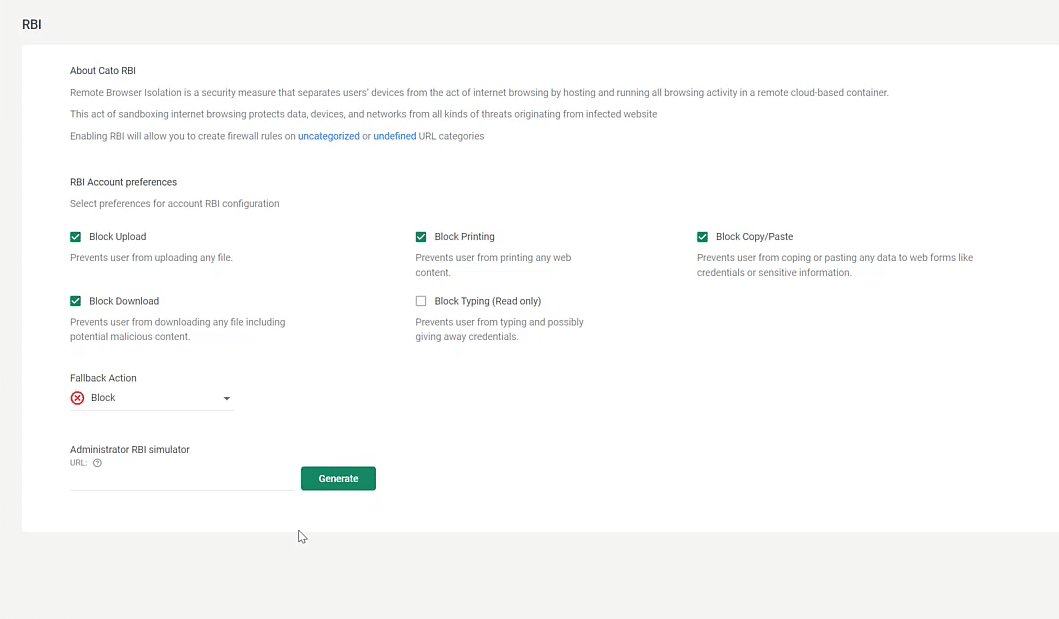
Cato RBI can be enabled in just a few clicks for all locations and users, with no additional hardware or software to deploy.
Enable in a few clicks for all users and locations
No additional hardware or software
Uncategorized sites auto-isolated in a remote session
Complete isolation
Reduce the risk of web-based attacks
RBI isolates website code from the endpoint by rendering the site in a containerized environment that is destroyed completely at the end of the session.
Render sites in a containerized environment
Session destroyed completely when it ends
A safe alternative to outright blocking sites
See it in action
Watch how Cato does it

Remote Browser Isolation Video Demo
Customer Stories
Customers love Cato
“
Remote Browser Isolation provided a niche capability for reducing our attack surface by isolating access to uncategorized sites that fall outside Cato’s existing categories. For those unknown sites, we needed a way to protect ourselves, so we started the RBI journey.
IT Leader
Global Trading Company

Network & Infrastructure Engineer
Midsize Business Law Firm

IT/Security Leader
Home Services Company
IT/Security Leader
Global Industrial Company
IT Leader
Industrial Services Organization
Get a live demo
Secure every interaction across the enterprise, cloud, and AI with the only purpose-built SASE platform.
What to expect

15–30 minute session with a SASE product expert

Discuss your use cases and how we can help

Live product demonstration where applicable
Get Started
See Cato in Action
What’s new
Latest resources and insights

Webinar

Solution Brief
FAQS
Answers to common questions
How does Cato RBI isolate risky browsing without disrupting users?3 questions
What is Remote Browser Isolation and why does it matter for enterprise security?
Remote Browser Isolation (RBI) protects endpoints by rendering web content in a containerized cloud environment rather than executing site code locally on the user’s device. This eliminates the risk of malware, credential theft, and other web-based attacks that occur when browsing runs directly on the endpoint. The containerized session is completely destroyed at the end of each browsing session.
How does Cato RBI handle uncategorized or unknown websites?
Cato RBI automatically routes uncategorized and undefined websites into a remote, isolated session. Instead of forcing administrators to choose between blocking a site entirely or allowing it to run on the endpoint, RBI provides a safe middle ground that keeps users productive while containing any potential risk.
How does RBI compare to simply blocking access to risky or unknown websites?
Outright blocking unknown sites protects against threats but disrupts productivity when users have legitimate reasons to visit uncategorized pages. RBI serves as a safe alternative by allowing access while ensuring that site code never reaches the endpoint. Users get a streamed graphical representation of the content rather than direct execution of potentially malicious code.
How does Cato RBI fit into broader access and security architecture?2 questions
How does Cato RBI fit into a broader security architecture?
Cato RBI is part of the converged Cato SASE Cloud platform. This means it operates alongside other networking and security capabilities within a single platform rather than as a standalone point product, giving organizations consistent policy enforcement and visibility across all users and locations.
What is the difference between Remote Browser Isolation and an Enterprise Browser?
RBI is a threat prevention capability that isolates browsing sessions to prevent malicious web content from reaching the endpoint. An Enterprise Browser, such as the Cato Enterprise Browser, is a managed workspace designed to provide secure, policy-controlled access to SaaS and private applications, with granular controls like restricting file downloads or copy-paste actions on unmanaged devices. The two serve complementary but distinct security purposes.
How does Cato RBI deploy, monitor, and support enterprise users?3 questions
Does deploying Cato RBI require new hardware or software agents?
No. Cato RBI is cloud-delivered and can be enabled in just a few clicks for all locations and users. There is no additional hardware to procure, no endpoint agents to install, and no browser plugins required.
What visibility does the platform provide into isolated browsing activity?
Cato RBI tracks browsing events by destination, user, and volume. Administrators can monitor RBI activity and use tools such as the RBI URL simulator to review how specific sites are handled within the platform.
Which desktop browsers are supported for isolated sessions?
Cato RBI supports major desktop browsers including Chrome, Edge, Firefox, and Safari. Mobile browsers are not currently supported.


