
IoT/OT Security
See every device. Even the unmanaged ones.
Cato IoT/OT Security extends protection to IoT and OT environments with real-time device discovery and classification, granular policy enforcement, and comprehensive threat prevention.

Today’s Challenges
Unmanaged devices are unseen risk.


IoT/OT blind spots
Unmanaged IoT and OT devices go undiscovered, leaving a critical attack surface no one fully sees.
Blind spots
Attack surface
Product sprawl
Siloed tools
Our approach
Discover every device.
Govern every connection.
Unmanaged IoT and OT devices expand the attack surface in ways agents can’t reach. Cato discovers and classifies every device, then segments and protects it through the same cloud platform — no additional sensors or appliances required.


Discover every device
Purpose-built AI/ML fingerprint devices across IT, IoT, and OT — mapping type, manufacturer, and version, with no integration required.

Enforce granular policy
Control device access to internal and external resources by characteristic or by group, shrinking the attack surface.

Prevent threats natively
Apply the full Cato Threat Prevention stack — IPS, NGAM, Sandbox, DNS security, and inline AI/ML — to IoT/OT devices.
White Paper
IoT/OT security that works as hard as your devices
How it works
IoT/OT Security Capabilities
AI/ML device fingerprinting
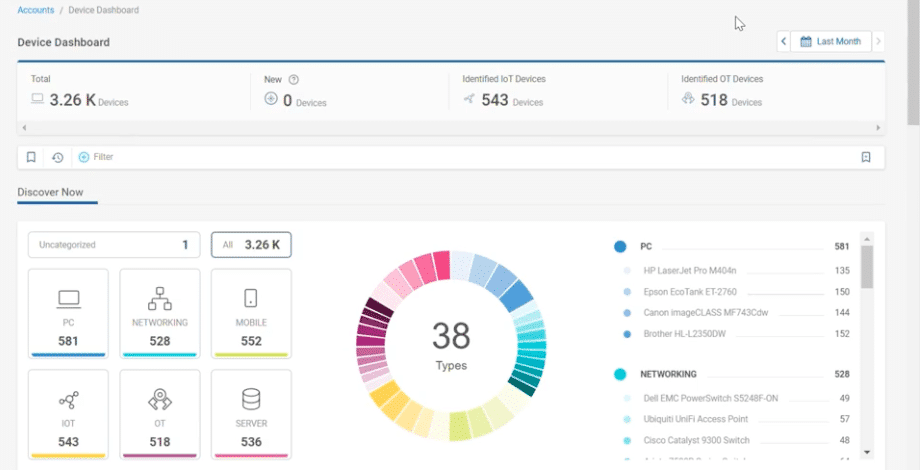
Instant device discovery and classification
Purpose-built, trained AI and ML fingerprint devices on the network, mapping their type, manufacturer, and version.
Effortless visibility across IT, IoT, and OT
Map device type, manufacturer, and version
No integration required — native to the platform
See it in action
Watch how Cato does it

Correlate Device Classification and Event Visibility with Cato SASE
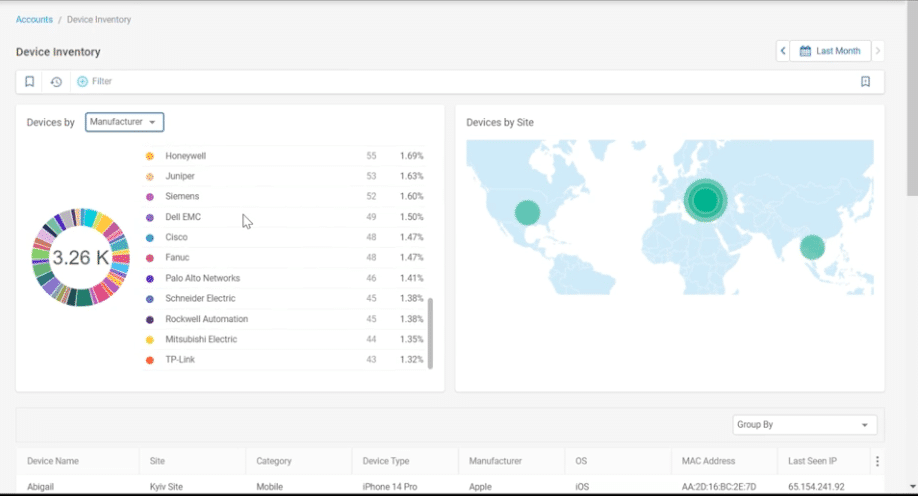
Extend IoT/OT Device Visibility in Cato SASE Cloud
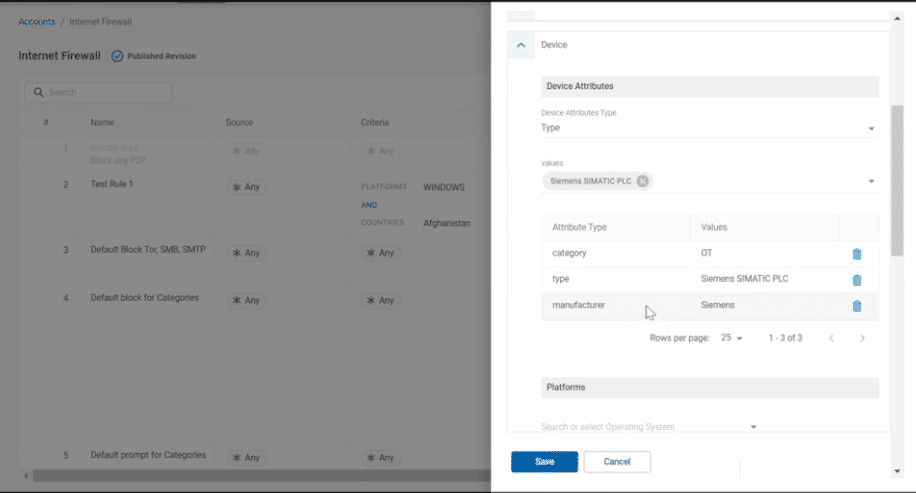
Enforce Policies for IoT/OT Devices with Cato SASE
Customer Stories
Customers love Cato
“
This is exactly what we’re after. Compared to our current OT approach, Cato centralizes everything and improves management by providing greater visibility and fine-grained access controls.
IT Leader
Medical Device Company

IT Leader
Global Manufacturing Company

Get a live demo
Secure every interaction across the enterprise, cloud, and AI with the only purpose-built SASE platform.
What to expect

15–30 minute session with a SASE product expert

Discuss your use cases and how we can help

Live product demonstration where applicable
Get Started
See Cato in Action
What’s new
Latest resources and insights


WHITE PAPER
IoT/OT security that works as hard as your devices
EBOOK
SASE in Manufacturing
FAQS
Answers to common questions
How does Cato discover and identify unmanaged IoT and OT devices?3 questions
What is Cato IoT/OT Security and what does it do?
Cato IoT/OT Security helps organizations discover, classify, monitor, and control connected devices that often cannot run endpoint agents. Native to the Cato SASE Cloud Platform, it combines Device Inventory, device-aware firewall policies, segmentation, and applicable threat-prevention controls in the Cato Management Application. It uses traffic already visible to Cato, so dedicated discovery sensors are not required.
How does the platform discover and classify unmanaged IoT and OT devices?
Cato Device Inventory passively analyzes WAN-bound and outbound traffic visible to the Cato Cloud. AI and machine learning identify attributes such as device category, type, manufacturer, model, operating system, and operating system version as confidence permits. No endpoint agent or dedicated discovery sensor is required. Identification can take up to 12 hours, and available detail depends on observed device traffic.
What types of organizations benefit most from this kind of IoT/OT security solution?
Cato IoT/OT Security is suited to organizations with connected devices that are unmanaged or cannot run endpoint agents. Common examples include manufacturers protecting industrial systems and healthcare organizations managing connected medical devices. It also supports distributed environments that need centralized device visibility, attribute-based access control, LAN segmentation, and threat monitoring across multiple sites.
How does Cato IoT/OT Security simplify operations and extend device context?3 questions
How does a SASE-native approach to IoT/OT security compare to traditional point solutions?
Separate IoT/OT products may introduce dedicated sensors, consoles, policy systems, and integration work. Cato brings device discovery, device-aware access control, segmentation, and applicable threat protection into the same platform used for networking and security. This reduces tool sprawl and gives administrators shared device context across inventory, policy, and event investigation.
Does Cato IoT/OT Security require new hardware or a separate interface?
For an existing Cato-connected site, Device Inventory does not require dedicated discovery appliances, sensors, or endpoint agents. Administrators use the Cato Management Application for device inventory, policies, dashboards, and events. Licensing is required for Device Inventory. Optional third-party connectors, such as Armis, are configured in the same management application.
Which third-party integrations complement Cato IoT/OT Security?
Cato supports asset-management integrations with Armis Centrix, Microsoft Intune, and CrowdStrike. These connectors can enrich Device Inventory with discovery, compliance, or endpoint context, while policy enforcement remains in Cato. Cisco Meraki integrates with Cato Experience Monitoring to correlate LAN and WAN performance for troubleshooting; it serves a different operational purpose from Device Inventory enrichment.
How does Cato control access and prevent threats across IoT and OT?3 questions
Can I control which resources each device can access?
Yes. Administrators can use detected device attributes in WAN, Internet, and LAN Firewall policies to control access to internal and external resources. Rules can use attributes such as category, type, manufacturer, model, operating system, and operating system version. This supports least-privilege access for identified devices without relying only on static IP addresses.
What threat prevention capabilities apply to IoT and OT devices?
Cato applies licensed security services, including IPS, Anti-Malware, Next Generation Anti-Malware, Cato Sandbox, and DNS Security, to applicable WAN and Internet traffic traversing the Cato Cloud. TLS Inspection expands visibility into encrypted traffic. Suspicious Activity Monitoring adds monitoring for activity that is not definitively malicious. For local east-west traffic, LAN IPS runs on supported Sockets and inspects traffic selected by LAN Firewall rules.
How does Cato help limit lateral movement between IoT and OT devices?
Cato LAN Firewall and microsegmentation policies control east-west communication locally on the Cato Socket. Microsegmentation can isolate hosts within the same VLAN and steer their traffic through the Socket for inspection. Administrators then permit required communications and restrict other paths, helping contain compromised devices and reduce unauthorized lateral movement.


