
Frontier AI
Don't React to AI Attacks. Stay Ahead of Them
See how Cato’s new Agentic Threat Prevention stops AI-powered attacks
Accelerated Agentic Protection Against Vulnerabilities
Learn how Cato’s architecture and Agentic CVE Mitigation accelerate protection against AI-powered attacks.

Today’s Challenges
AI-Powered Attacks
89%
YoY increase in attacks by AI-enabled adversaries
Agentic attackers can identify and chain multi-stage attacks.
Source: CrowdStrike Learn about Agentic Threat PreventionProtection Against Newly Discovered CVEs
#1
Breach entry point
Vulnerability exploitation is already the #1 initial access vector for breaches, at 31%.
Source: 2026 Verizon DBIR Learn about Agentic CVE MitigationThe Cato Solution
Architecture matters more than ever
In the age of Frontier AI, architecture is no longer a design choice — it is foundational in determining whether organizations stay secure.
Cato’s cloud-native, converged architecture is the foundation for Agentic Threat Prevention and Agentic CVE Mitigation, enabling customers to predict emerging threats, adapt protections automatically, and scale protection everywhere without appliance constraints while delivering rapid exploit protection.
Cloud
Cato delivers protections from the cloud, so new defenses can be pushed globally without waiting for customer-managed appliance upgrades or patch windows. Protection becomes an always-on service instead of a rollout project.
Context
Cato sees users, applications, traffic, identity, and events through one shared context layer. That lets Cato detect threats more accurately, validate protections faster, and reduce the blind spots created by isolated tools.
Converged
Because networking and security run on one platform, new protections don’t have to be stitched across separate products or policy engines. One platform, one policy, and one enforcement path help Cato move from protection creation to active coverage faster.
Free eBook
Can your security architecture prevent attacks at AI speed?
Agentic Threat Prevention
Stay ahead of AI-powered attacks
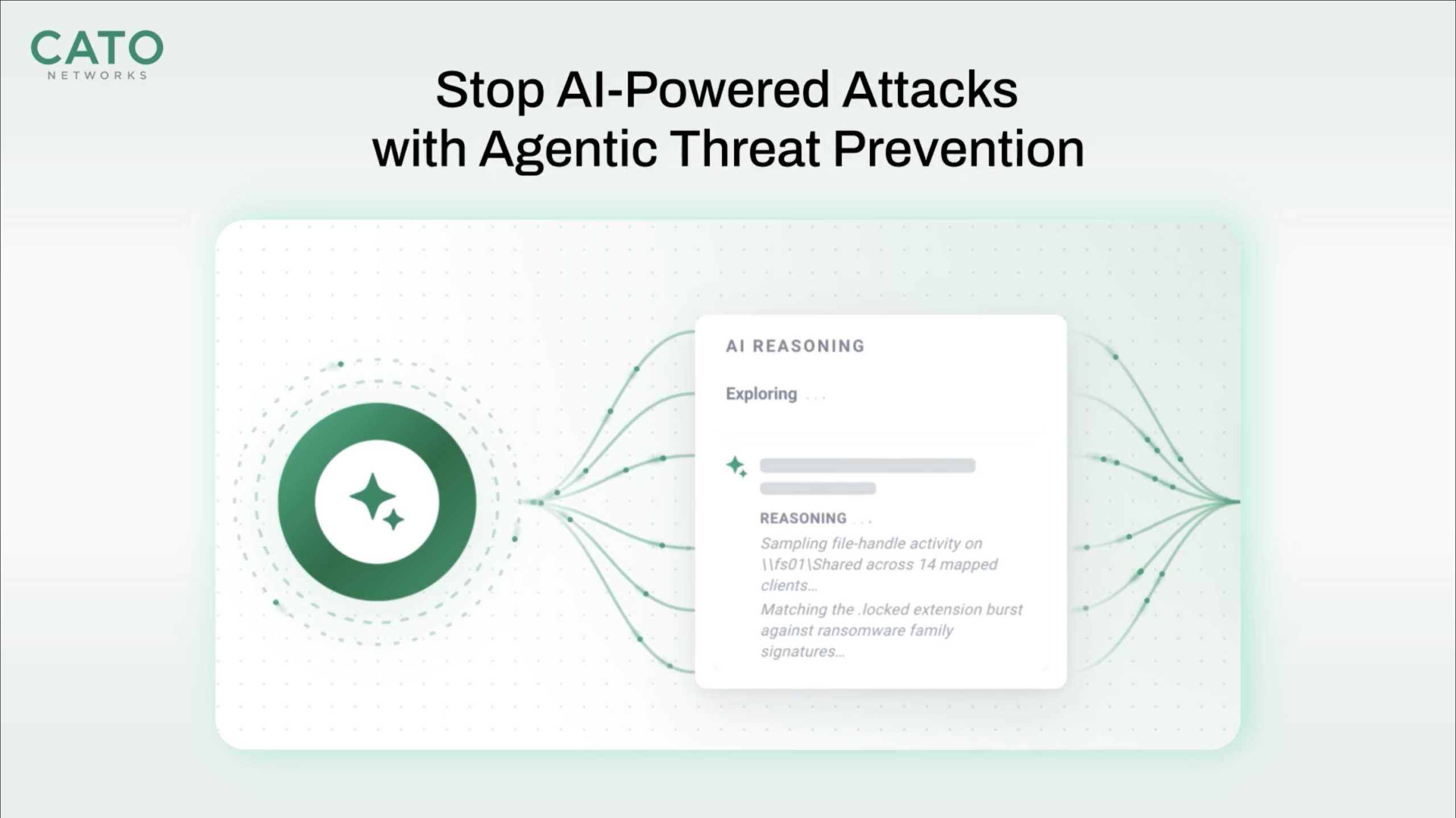
Cato Agentic Threat Prevention brings specialized defensive agents into the Single Pass Cloud Engine (SPACE) to anticipate enterprise-specific attack paths, adapt protections autonomously, and scale resources as attack traffic surges. Instead of waiting for manual analysis, static signatures, or appliance updates, Cato adapts prevention to each enterprise’s environment as attacker indicators, behavior, and adaptations change.
Predict based on context
Apply shared context for a holistic view of network assets and security events that drive accurate predictions of attacker’s likely next steps.
Adapt policies autonomously
Adjust policy at machine speed to block predicted actions and disrupt adaptive, multi-stage attacks.
Scale defenses automatically
Expand cloud resources on demand as AI-powered attack traffic surges, avoiding appliance limits and protection-depth tradeoffs.
Agentic CVE Mitigation
The industry’s fastest time to protection
Cato set a new benchmark for CVE mitigation, reducing time-to-protection for newly disclosed vulnerabilities to as little as 45 minutes. By combining agentic threat research with Cato’s cloud-native architecture, new protections can be analyzed, validated, and deployed globally before traditional patch cycles can even get moving.
Read the blog
Time to protection is the new KPI
Cato’s Agentic CVE Mitigation automates CVE notification, analysis, protection, and validation at machine speed — helping move cloud-delivered protection from days to minutes.
CVE protection at AI-driven scale
Cato automatically creates and distributes new protections across its global cloud platform, helping customers stay protected as CVE volume grows — without added operational workload.
Cloud-delivered, no delays
Cato’s cloud-native platform is updated automatically, removing the burden of customer-owned appliance patching across distributed security infrastructure.
Cato puts Frontier AI to work for defenders
Cato Joins OpenAI’s Trusted Access for Cyber (TAC) to Advance AI-Driven Defense
Read the blogCato Advances Enterprise Defense, Joining the OpenAI Daybreak Cyber Partner Program
Read the blogCustomer Stories
Customers love Cato
We've made significant progress strengthening our infrastructure. With a solid foundation in place, we're confident building and scaling new technologies across our stores.
What’s New
Latest news and resources
The Vulnerability Tax: What CVE Response Costs at the Network Edge
See how network edge vulnerabilities drive IT costs, downtime risk, and emergency patching.
Read blogFrom CVE Disclosure to Agentic Protection in 45 Minutes
Why machine-speed, cloud-delivered protection matters now.
Read blogWhy Legacy Security Can’t Keep Up With Frontier AI
Attackers are operating at AI speed. Are your defenses?
Get the eBookThe Mythos Moment
What the Mythos moment signals for AI-accelerated defense.
Read blogBeyond Patch SLAs: Continuous Protection in the Frontier AI Era
Why time-to-protect, not patch timelines, is the metric that matters now.
Read blogFrontier AI and the Demise of Hardware Security
Why frontier AI is ending the era of hardware-bound security.
Read blogReducing Time-to-Protect with Cato's Self-Evolving Vulnerability Protection Agent
Inside the agentic workflow that took CVE-to-protection to 45 minutes across 20 real-world vulnerabilities.
Read blogCato Joins OpenAI's Trusted Access for Cyber (TAC)
How access to restricted frontier cyber models advances AI-driven defense for trusted defenders.
Read blogGet a live demo
Secure every interaction across the enterprise, cloud, and AI with the only purpose-built SASE platform.
What to expect
 15–30 minute session with a SASE product expert
 Discuss your use cases and how we can help
 Live product demonstration where applicable
Get Started
See Cato in Action
Request received
Thanks, there. A Cato specialist will reach out at to schedule your session.
FAQS
Answers to common questions
What has changed with frontier AI?
Frontier AI models can accelerate attacker workflows that previously required specialized human expertise. The near-term change is not only new attack techniques, but the speed, scale, and adaptability of reconnaissance, vulnerability analysis, exploit development, and multi-stage attack planning. Many attacks will still use familiar techniques such as exploiting vulnerabilities, abusing credentials, phishing, and moving laterally after initial access, but AI can make those workflows faster and easier to scale.
Why should customers care now?
Customers should care because AI accelerates the attack timeline while many defenses still depend on manual patch cycles, appliance updates, and fragmented tools. As vulnerability volume rises and attacks become more adaptive, the security advantage shifts to teams that can reduce exposure quickly, correlate activity across the environment, and enforce protections before attacks progress.
What is Cato doing in response to frontier-AI-accelerated threats?
Cato has shifted focus from “time-to-patch” alone to time-to-protection: faster exposure assessment, runtime validation, inline enforcement, and AI-assisted security workflows. This is reflected in Cato’s work around Agentic Security Researchers, Dynamic Threat Prevention, and continuous protection for AI-accelerated disclosure cycles. Read more in our blog: Reducing Time-to-Protect with Cato’s Self-Evolving Vulnerability Protection Agent.
How will Cato handle the anticipated CVE surge?
Cato combines AI-assisted vulnerability triage, Cato CTRL research, runtime validation, Agentic CVE Mitigation, and cloud-delivered inline protections. The goal is to prioritize CVEs that are exploitable, reachable, prevalent, and relevant, then convert them into enforceable protections quickly and safely.
Does Cato have access to the latest frontier AI models?
Yes. Cato is a participant in OpenAI’s Trusted Access for Cyber program, giving Cato access to GPT-5.x-Cyber for defensive workflows such as CVE discovery, prioritization, triage, validation, and mitigation that are similar to Anthropic’s Mythos. Read more in our blog: Cato Joins OpenAI’s Trusted Access for Cyber (TAC) to Advance AI-Driven Defense.
What is time to protection?
Time to protection is the time between vulnerability disclosure and effective customer protection. It is different from time to patch. Patching fixes vulnerable software, while protection can also include inline controls, virtual patching, threat signatures, policy changes, and other compensating controls that reduce exposure while remediation continues.
Is patching still important?
Yes, patching remains essential. Cato Agentic CVE Mitigation and related protections help reduce exposure while patching, validation, and formal remediation continue. The goal is not to replace patching, but to reduce the exposure window while customers complete remediation safely.
Why does Cato’s architecture matter?
Frontier AI magnifies the shortcomings of appliance-based security. Fixed capacity, upgrade cycles, distributed enforcement, and fragmented policies become major constraints as CVE volume, signature demands, deeper inspection, and attack traffic increase. Cato’s cloud-native, converged architecture is the key delivery mechanism that ensures the fastest, most complete customer protection instead of the delayed, fragmented process of updating traditional security stacks. Moreover, Cato’s cloud-native platform scales defensive resources automatically, as AI-driven attack volume and inspection requirements increase.
How does Agentic CVE Mitigation differ from agentic prevention capabilities?
Agentic CVE Mitigation addresses one urgent problem: reducing exposure quickly after newly disclosed vulnerabilities appear. Agentic prevention capabilities address a broader challenge: adaptive, multi-stage attacks that may change tactics as they move through an environment. Cato is expanding prevention capabilities that leverage shared platform context and AI-assisted workflows to help predict and identify attack progressions and apply protections earlier.
What role does Dynamic Prevention play?
Dynamic Prevention helps detect and stop evasive, low-and-slow, and multi-stage attacks by correlating activity across users, devices, applications, network traffic, and security signals. It moves beyond static indicators by using context to identify suspicious progressions that may be hard to see when each event is viewed in isolation. Agentic prevention will work closely with Dynamic Prevention in customizing, predicting, and stopping frontier AI attacks in real time.
What if a malicious AI agent behaves like a legitimate user?
Activity that uses valid credentials, approved tools, or a compromised endpoint can be difficult for static controls to distinguish from normal behavior. Cato helps address this by correlating identity, device, application, traffic, and shared context so suspicious progressions can be detected earlier and adaptive restrictions can be applied when risk conditions converge.
How is this different from Cato AI Security?
Cato AI Security helps organizations secure the AI they use, protect the AI they build, and control AI agents. Agentic CVE Mitigation and agentic prevention capabilities are part of the agentic SSE architecture and use AI workflows to make security operations and threat prevention faster and more adaptive. They are complementary: one helps govern enterprise AI adoption, while the other helps defend against faster, AI-assisted threats.
What is Agentic CVE Mitigation, and how does it work?
Agentic CVE Mitigation is Cato’s human-supervised, AI-assisted workflow for turning newly disclosed vulnerability intelligence into validated, cloud-delivered threat protections. It helps Cato security researchers monitor new vulnerability disclosures, analyze exploit behavior, develop candidate protections, test them for quality and false-positive risk, review them, and deploy approved protections through the Cato Cloud Platform. Read more in our blog: Reducing Time-to-Protect with Cato’s Self-Evolving Vulnerability Protection Agent.
What does the 45-minute time-to-protect proof point mean?
Cato announced that Agentic CVE Mitigation reduced time to protect for newly disclosed vulnerabilities to as little as 45 minutes in tested workflows. This is a proof point for how quickly Cato can generate and validate protection in this model. It should not be read as a blanket SLA for every vulnerability or every environment.
Does Agentic CVE Mitigation require customer action?
No, Agentic CVE Mitigation is an active part of Cato’s backend operations, so customers automatically benefit without additional licensing or enabling features. Cato delivers these validated protections through the Cato Cloud Platform with no software updates or configuration required. Customers should still follow their normal patching, asset management, and remediation processes for affected systems.
Does Cato only protect against known CVEs?
No, Agentic CVE Mitigation focuses on newly disclosed vulnerabilities and associated exploit behavior, but it is part of a broader prevention strategy that also includes threat intelligence, inline security controls, Dynamic Prevention, AI/ML-driven detection, and investigation workflows for emerging and multi-stage threats.
What should customers do now?
Continue patching critical vulnerabilities, reduce public exposure, review high-risk assets, enforce least privilege, invoke segmentation, inspect encrypted traffic where appropriate, and make sure security controls can correlate activity across users, devices, applications, data, and network traffic. Customers using Cato should also review their threat prevention, SSE, AI Security, and incident detection capabilities with their Cato team. Contact Us to schedule a threat prevention/SSE review with the Cato team.
How is customer context handled?
Cato uses platform context within the scope of licensed services, customer policy, and applicable agreements to enforce security controls, detect threats, and improve protection. Customer-specific security reviews, privacy questions, and compliance evidence should be handled through the standard Cato account, security, or compliance process.
Can Cato brief our security, risk, or executive team?
Yes, Cato can brief customers on frontier AI threat trends, Agentic CVE Mitigation, Cato’s prevention strategy, and practical steps to reduce exposure. Customer-specific architecture, compliance, or roadmap questions should be handled through the account team, or Contact Us to schedule a threat prevention/SSE review with the Cato team.


