Your First Move Matters: What Chess Teaches Us About Enterprise Architecture


|
Listen to post:
🔊 This audio player requires that "Preferences" cookies be accepted
|
In a world where technology, threats, and business priorities evolve constantly, the real challenge is not predicting the future, but choosing an architecture that can adapt to it.
The First Move Shapes More Than the Opening
In chess, strong players do not try to predict every move. They build positions that preserve room to adapt. Enterprise architecture should be approached the same way. The first move rarely decides the outcome, but it often shapes the quality of every move that follows.
Most organizations start where the pressure is greatest. That first move may be U-ZTNA to secure access, SSE to protect SaaS usage, SD-WAN to modernize connectivity, or AI Security to respond to new forms of risk. Each is a valid starting point. The bigger question is whether the architecture behind that first decision gives the business room to expand, integrate, and adapt over time, or whether it creates constraints that only become visible later.
It affects how quickly the company can integrate an acquisition, open in a new market, respond to regulatory change, or roll out a new capability without reopening the environment underneath it. Architecture is no longer just a technical concern. It has become a direct factor in business speed, resilience, and control.
The Environment Is Changing Faster Than Planning Cycles
Threat models keep evolving. Application architectures keep shifting. New priorities emerge faster than traditional planning cycles can absorb them. Generative AI is a clear example. For many organizations, it was barely part of the roadmap not long ago. Today, it is not just raising new questions around governance, data protection, visibility, and control. It is also forcing leaders to ask a broader question: how do we enable this safely, and where does the business actually create value from it?
Business priorities can shift faster than most planning cycles can respond. New regulations, operating changes, expansion plans, and shifting market conditions can quickly alter what the architecture needs to support. That makes rigid architectural assumptions difficult to defend over time.
“For me, Cato future proofs Swissport’s IT infrastructure. The platform constantly evolves, adapts to new technologies, and provides the visibility and security we need to support our business today and tomorrow.”
Richard Thorp, CTO, Swissport.
Architecture can no longer be built around one expected destination. It has to be built around the ability to adjust, sometimes gradually, sometimes abruptly, without slowing the business each time conditions change.
Swissport Elevates Security, Global Operations with Cato Networks | Read the storyThere Is No Single Journey
Some organizations begin with U-ZTNA. Others start with SSE. Some modernize the network first with SD-WAN. Others move quickly on AI Security because that is where urgency suddenly appears. From there, the journey can unfold in many different ways depending on contracts, organizational ownership, geography, business priorities, and external events.
Most organizations start with one capability, coexist for a period with existing tools and active contracts, and expand over time. That is not a weakness in strategy. It is simply how large enterprises evolve in the real world.
If the business moves in stages, the architecture must do the same. Otherwise, each subsequent step adds friction: new dependencies, greater operational complexity, slower change, and greater coordination overhead.
When Expansion Becomes a New Project
It appears later, when the business needs to move again. A first initiative can look successful on its own and still create problems the moment the organization needs to extend it. A new requirement may introduce another infrastructure layer, another policy model, another console, another workflow, or another operational boundary. Instead of extending the architecture, teams find themselves redesigning it.
The more fragmented the architecture, the more fragmented accountability can become. When multiple vendors, service providers, and integration partners are involved, even simple changes can take days as teams work to identify where responsibility begins and ends. Complexity is not only created by technology. It is also created by unclear ownership.
Acquisition integration can slip by months. A regional rollout can slow because policy changes require multiple teams and handoffs. A routine change can become an escalation path. Costs appear twice: once in technology, and again in coordination, delay, and redesign. Leadership expects responsiveness; the operating model delivers drag.
Modularity Preserves Optionality
In strategy, strength comes from keeping options open. The same is true in enterprise architecture. Modularity matters because it allows organizations to adopt capabilities as needed, without forcing them into a larger redesign each time priorities shift. When that modularity is delivered through a cloud-native architecture, without requiring new infrastructure at every step, the business gains flexibility without adding unnecessary complexity.
When capabilities share a common data plane, a single policy layer, consistent identity context, centralized visibility, and a coherent operating model, the organization is no longer forced to reconstruct the environment every time priorities shift.
New requirements can be introduced as extensions of the architecture rather than as separate systems that later need to be stitched together. It sounds like a subtle distinction. In practice, it changes everything. One model adds capabilities. The other adds integration work.
It means the business can absorb change without paying for it twice: once in technology, and again in delay, coordination, and redesign.
Adaptability Must Also Be Commercial
Organizations do not just change technically. They change commercially too. User populations rise and fall. New capabilities become priorities. Business units expand into new regions. Acquisitions bring new users, sites, and timelines. If the commercial model does not adapt with the architecture, routine change quickly turns into procurement friction, budget debate, or cost uncertainty.
A sound model should move up and down as user populations evolve, and left and right as capabilities expand over time, while remaining financially understandable and controllable. Adaptability loses much of its value when it creates budget instability.
The Lesson from Chess
That is the deeper lesson chess offers architecture leaders. Strong players do not depend on knowing exactly how the game will unfold. They prepare for multiple possibilities, preserve room to maneuver, and avoid closing off their own options too early.
The most important decision is not which capability comes first. It is whether the underlying architecture allows the organization to respond as technology, threats, and business priorities evolve without repeatedly slowing down the business in order to catch up.
The architectures that endure are the ones built to adapt when the future changes.


Related Articles
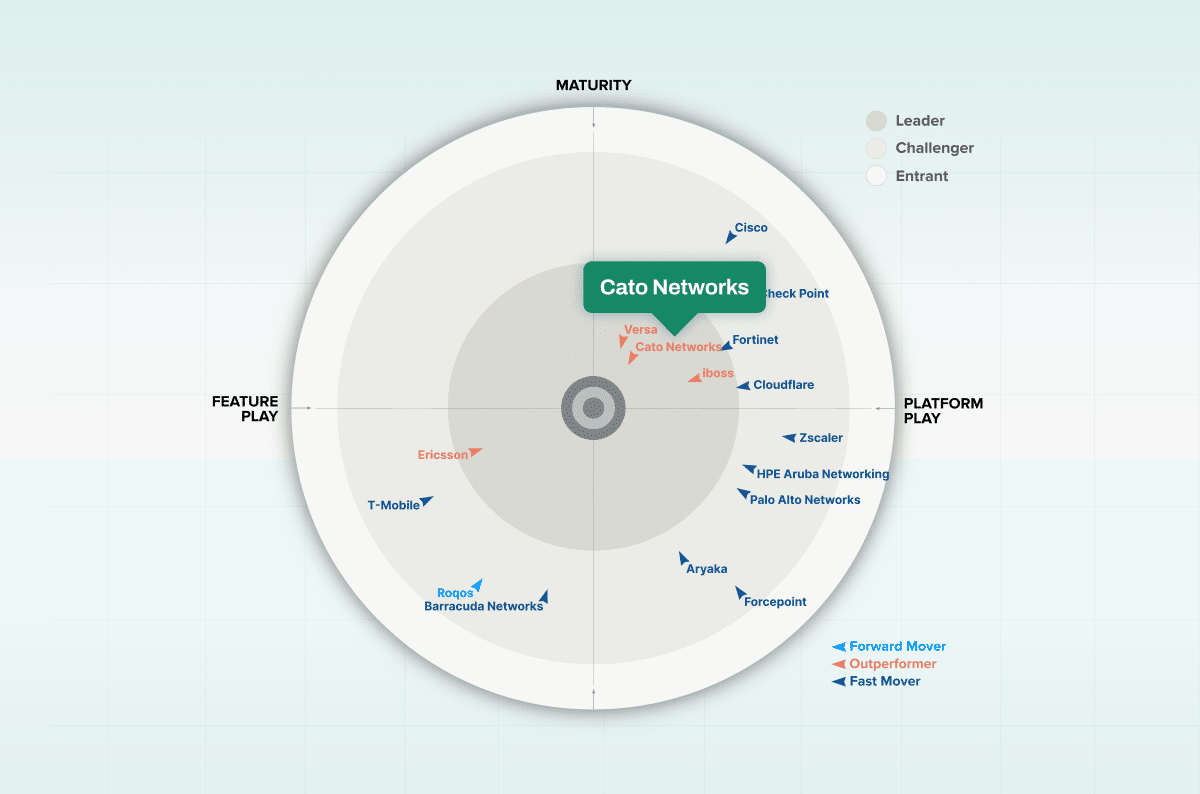
Cato Networks Named a SASE Industry Leader and Outperformer for the THIRD Consecutive Year

DuneSlide: Two Critical RCE vulnerabilities via Zero-Click Prompt Injection in Cursor IDE


Sentra and Cato XOps: Turning Data Risk into Active Mitigation