Same Attacks, New Speed: The Rise of Agentic Offensive Frameworks

Executive Summary
Agentic cyberattacks are no longer theoretical. In 2026, frameworks such as ARTEX, Cairn, CyberStrikeAI, and PentAGI moved from research and red team use into real-world attacker operations.
Our research shows that these frameworks are gaining adoption quickly. Across GitHub and Internet-exposure data, we found thousands of forks and more than 4,000 publicly visible servers, alongside growing interest in these tools within underground communities.
The underlying attack techniques, however, are mostly familiar. The real change is how quickly and autonomously attacks can be executed: agents can chain tools and attack stages, work in parallel, and adapt when blocked. For defenders, this makes broad visibility and multiple layers of protection across the attack chain increasingly important. Cato combines existing inline security controls with Agentic Threat Prevention (AGTP), designed to identify attack progression and help stop likely next steps before the attacker reaches its objective.
Agentic Attacks Are No Longer Theoretical – They Are Here
For more than a year, the cybersecurity industry has been asking the same questions: Are autonomous AI-driven attacks really possible? When will they move from research environments into real-world operations? And how much of the threat is real versus hype?
Throughout 2026, controlled testing started to answer that question. OpenAI disclosed models bypassing isolation during cybersecurity evaluations and reaching the internet, while Anthropic reported similar incidents. In July, Cato demonstrated an agentic attack stack reaching Domain Administrator in a controlled Active Directory environment in 40 minutes from a single high-level prompt, with most planning and execution handled autonomously. The capability was no longer hypothetical.
Over the past few weeks, however, the question has changed. We are no longer asking only whether agentic attacks can happen. We are now seeing threat actors actually use agentic offensive frameworks in real operations.
In October, researchers investigating attacks focused on Japan uncovered a CyberStrikeAI environment configured with 44 specialized agents spanning reconnaissance, exploitation, persistence, C2, exfiltration, and reporting. The activity involved at least 19 organizations, including 16 in Japan, with multiple targets processed in parallel. Deep compromise was limited to a smaller number of targets, but the case demonstrated how agentic tooling can automate attack operations at scale.
At roughly the same time, Microsoft observed the China state-aligned actor Storm-0940 using ARTEX to automate attacks against hundreds of organizations globally. Some successful attacks progressed from initial targeting to privileged cloud access in less than three hours. ARTEX was also used during activity associated with the ConnectWise Cloud Backup supply-chain compromise, while the FBI later reported that the compromise enabled access to more than 2,250 downstream tenants.
ARTEX is not an isolated case. Google Threat Intelligence Group and Mandiant reported threat actors using other open-source agentic frameworks, including Cairn and HexStrike, during real incident-response engagements. Since late August 2026, they observed these tools being used across multiple stages of the attack lifecycle, including lateral movement, database exploitation, and preparation for data exfiltration.
By November 13, the shift was significant enough for the FBI to publish a FLASH warning that a variety of malicious actors had weaponized ARTEX to automate multiple stages of cyber intrusions at machine speed. The FBI also highlighted financially motivated attacks against South Korean financial institutions that resulted in the exfiltration of personal information belonging to approximately 67,000 people.
Agentic offensive frameworks have moved from GitHub projects and controlled security research into the hands of real threat actors.
Four Popular Open-Source Agentic Offensive Frameworks We Examined
There are already dozens of AI-enabled offensive-security projects available publicly, ranging from experimental research agents to full multi-agent penetration-testing platforms. For this research, we chose to focus on four popular, free, open-source frameworks that have attracted significant public attention and have also appeared in real-world attacker activity: ARTEX, Cairn, CyberStrikeAI, and PentAGI.
These frameworks are not identical, but they share a common idea: reducing the amount of manual work required from the operator. Instead of executing every step of an intrusion themselves, an operator can provide a goal while the framework uses one or more agents to reason about the environment, select tools, execute actions, interpret results, and decide what to do next.
ARTEX is an autonomous, multi-agent penetration-testing and offensive platform that divides activity across specialized agents and translates high-level objectives into executable actions. Its original GitHub repository was removed in October 2026 following widespread abuse, but the code continued to spread through forks and localized versions. Google Threat Intelligence Group and Mandiant have observed ARTEX being used by both financially motivated and suspected espionage actors during real intrusions.
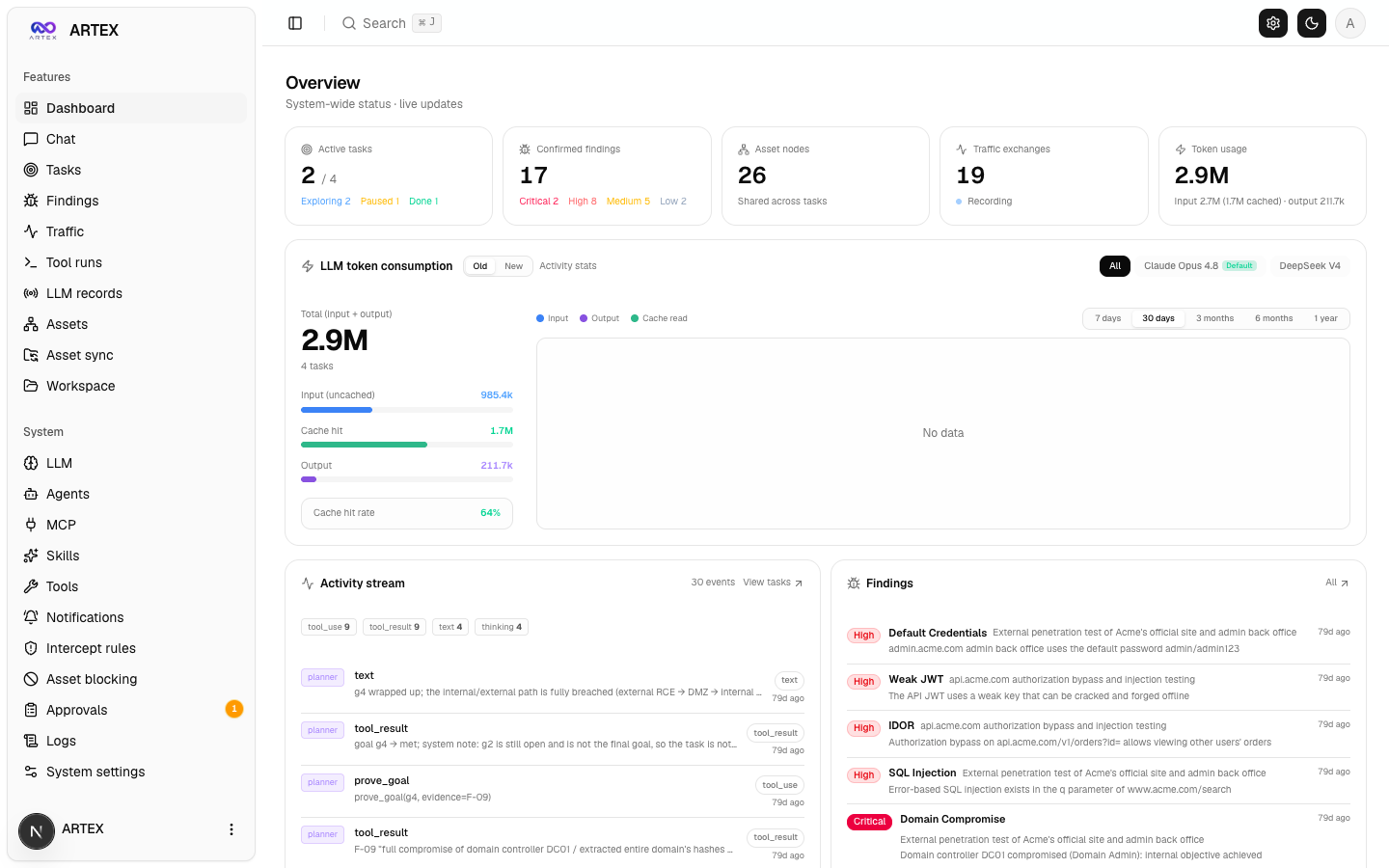
ARTEХ dashboard interface displayed in a GitHub repository, showing system activity, token consumption, active nodes, traffic exchanges, and security findings
Cairn takes a somewhat different approach. Rather than defining a fixed set of penetration-testing roles or workflows, Cairn is designed as a general-purpose state-space search engine. An operator provides a starting point and a goal, while multiple workers explore possible paths toward that goal using a shared graph of facts and intended actions. Penetration testing was the first domain in which the framework was validated, and Cairn has since been observed being operated by threat actors during real incident-response investigations.
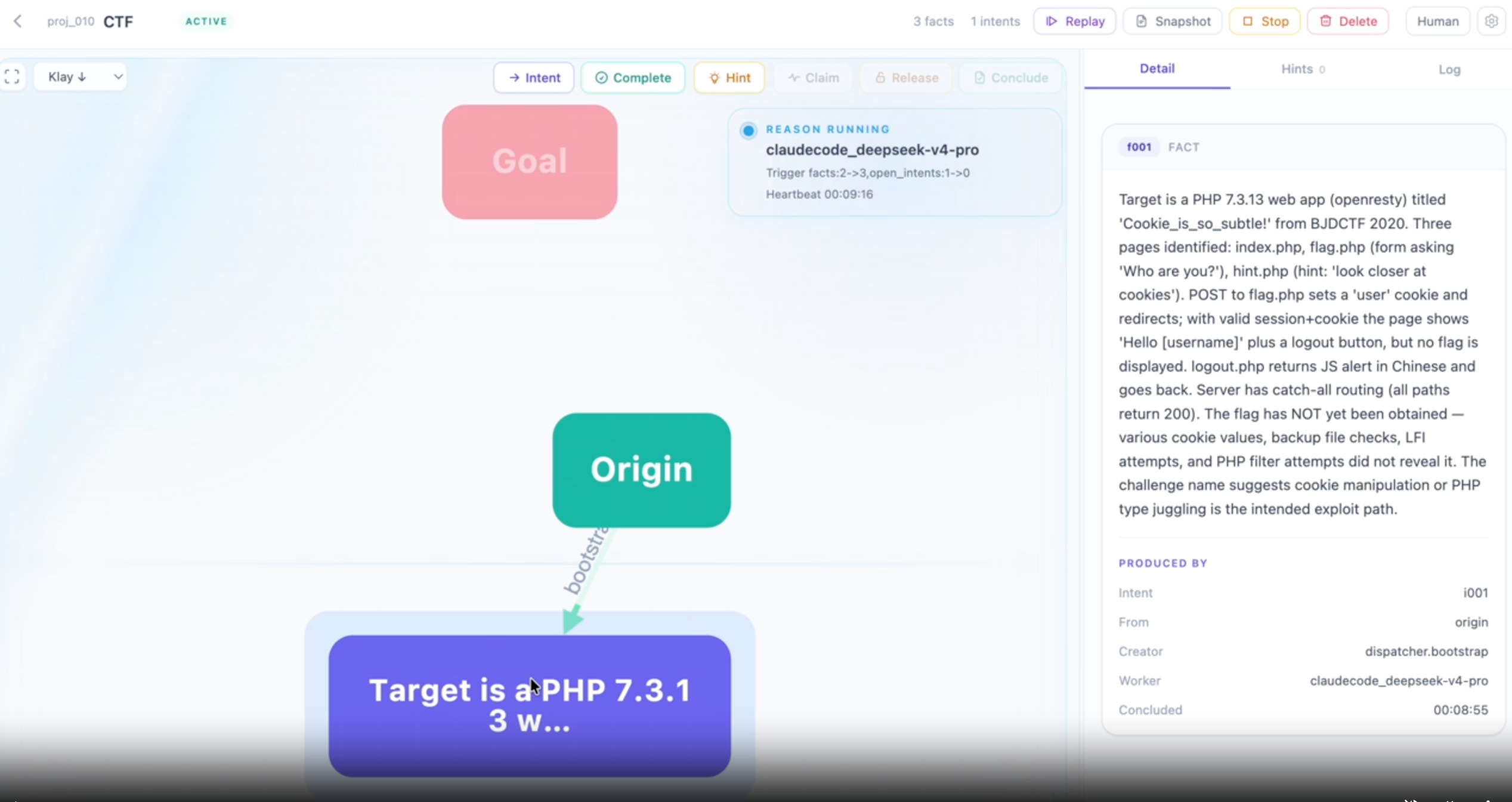
Cairn in action with a goal and target, showing its reasoning process and discovered facts during a CTF task
CyberStrikeAI is a broader offensive-security platform combining multi-agent orchestration, MCP-based tooling, knowledge retrieval, attack-chain modeling, a web console, and integrations with a large number of security tools. It also includes capabilities such as WebShell management and built-in C2 functionality. In October 2026, researchers examining attacker infrastructure found one CyberStrikeAI deployment configured with 44 agents, with work distributed across reconnaissance, vulnerability discovery, exploitation, persistence, command and control, exfiltration, and automated reporting.
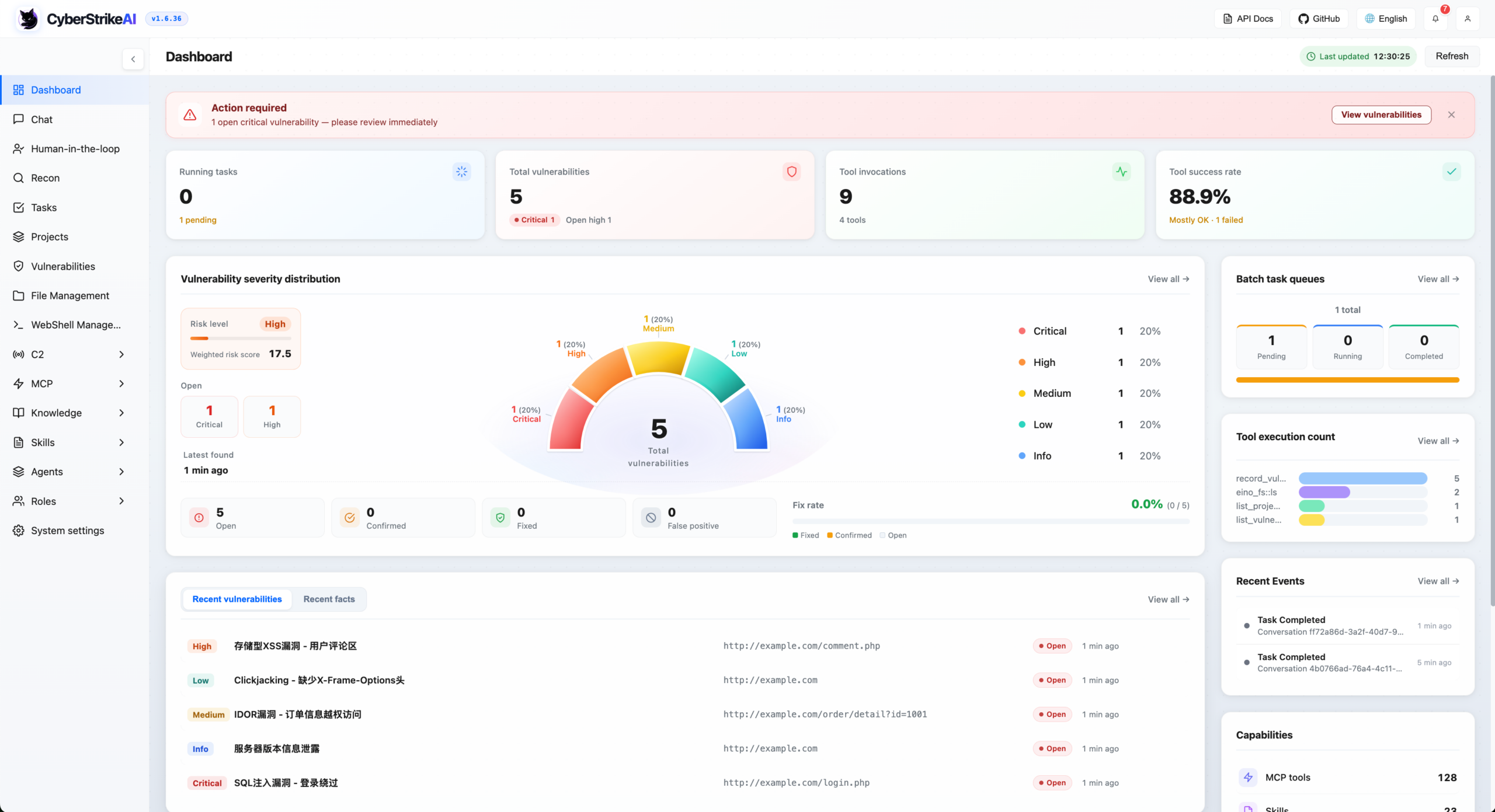
CyberStrikeAI dashboard in action, showing vulnerability severity, active tasks, tool executions, recent security findings, and system capabilities
PentAGI, developed by VXControl, is a multi-agent penetration-testing framework designed to take a target and goal and break the operation into tasks handled by specialized agents. Those agents can invoke established offensive tools such as Nmap, Metasploit, and SQLmap inside isolated environments rather than requiring the operator to manually coordinate each tool. GTIG and Mandiant have observed PentAGI being abused in the wild, including operations that progressed beyond reconnaissance and vulnerability scanning into active intrusion and persistence.
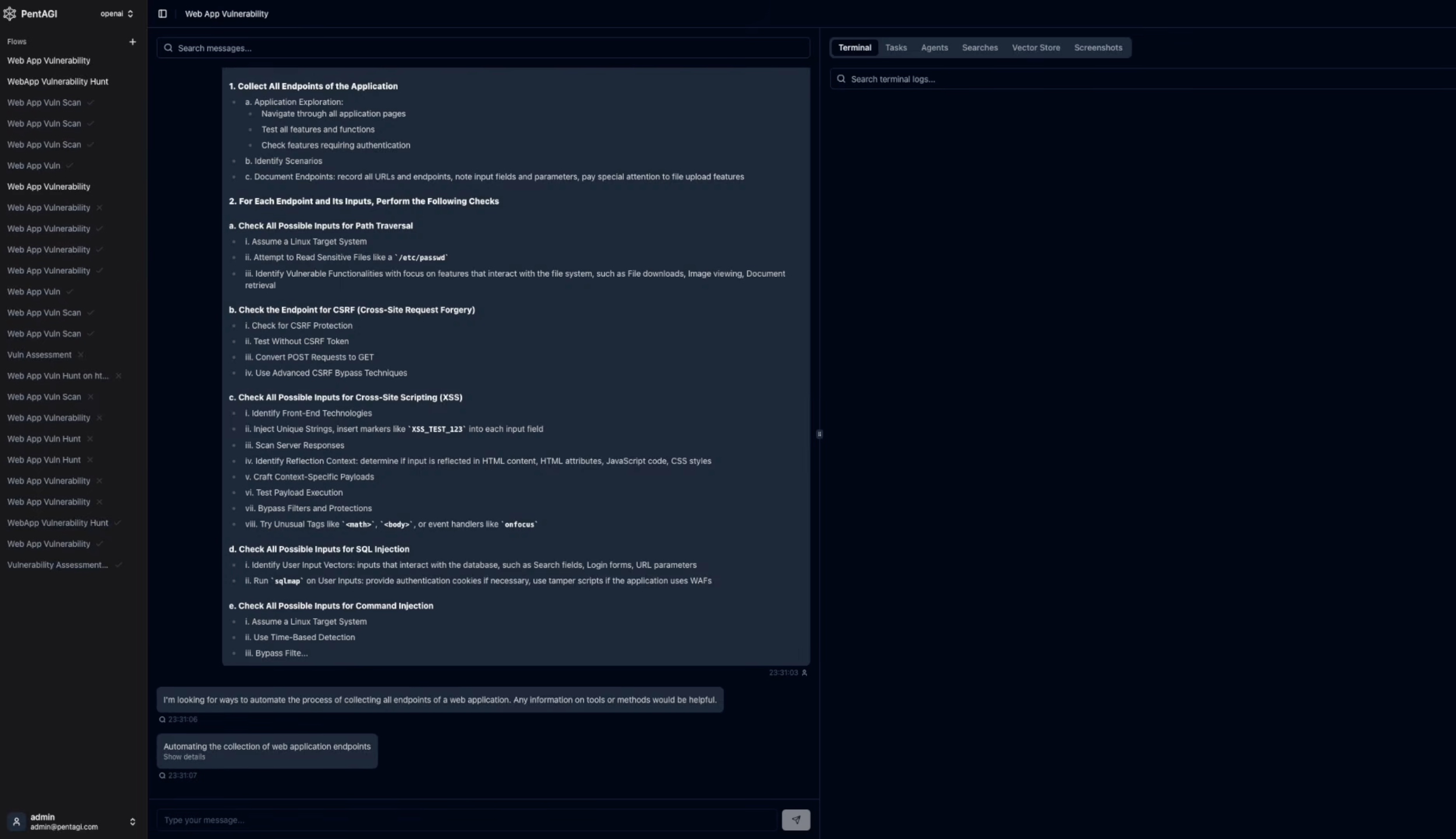
PentAGI in action during a demonstration by its creator, showing the chat interface coordinating agents to execute assigned web security tasks
We selected these four because they give us a useful sample of the broader ecosystem: they are popular, actively discussed, publicly accessible, and provide enough observable data to study their development and adoption over time.
From GitHub To The Attacker’s Toolbox
One way to understand how quickly these frameworks are spreading is to look at two different signals: developer/community activity on GitHub and Internet-facing deployments.
The GitHub numbers already show substantial interest around the four agentic frameworks we examined. As of November 15, 2026, PentAGI had more than 34,000 stars and 5,300 forks, CyberStrikeAI had more than 8,600 stars and 1,900 forks, and Cairn, despite being created only in April 2026, had already accumulated more than 5,100 stars and 1,000 forks. ARTEX is more difficult to measure because its original repository was removed, but four surviving copies together accounted for more than 10,000 stars and 7,700 forks.
This does not mean that newer agentic frameworks have replaced established offensive frameworks. In fact, the GitHub activity shows very different lifecycle patterns. Sliver remains actively developed, with more than 900 commits and 20 releases during the last 12 months, while Havoc is archived and had only two commits during the same period, despite continuing to gain forks.
GitHub activity only tells us part of the story. We also searched for publicly reachable deployments using open-source intelligence and Internet-search platforms such as Shodan and Censys.
Our searches identified:
These results should be treated as exposure indicators, not confirmed attacker infrastructure, and counts from Shodan and Censys should not be compared directly because the searches used different engines.
The Internet-exposure data shows that these frameworks are not limited to GitHub repositories or research environments – they are already being deployed on publicly reachable infrastructure. But deployment is only one part of the picture.
To better understand how quickly interest in these tools is growing, we also looked at their activity on GitHub. Rather than relying only on stars, we focused on forks and development activity: forks give us an indication of how frequently projects are being copied and picked up by others, while commits help show how actively the frameworks themselves are evolving.
GitHub forks created during the last 12 months:
New forks from November 2025 through October 2026:
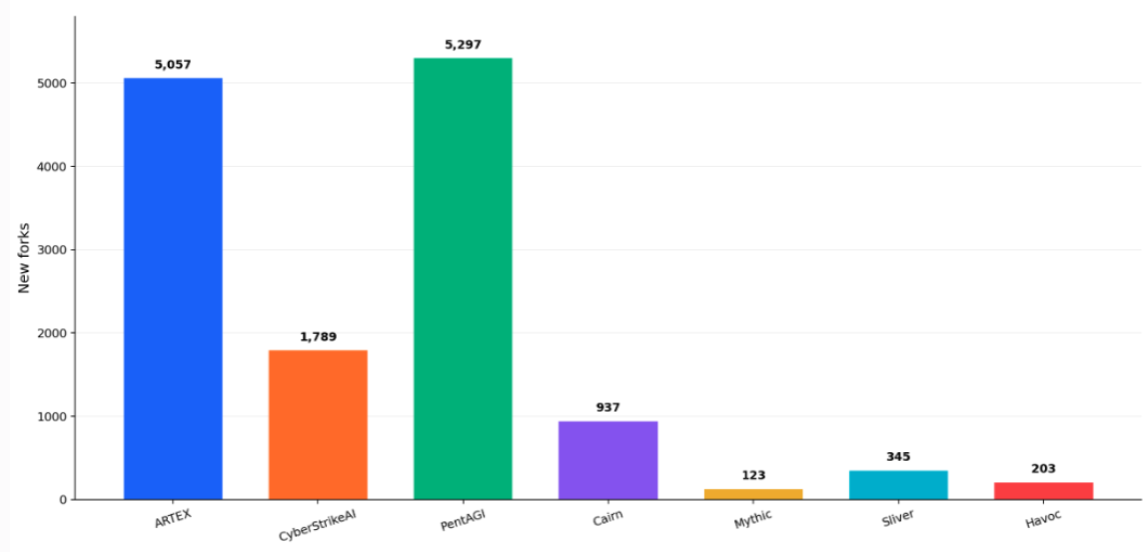
The difference in recent fork activity is significant. PentAGI recorded 5,297 new forks during the last 12 months, while the surviving ARTEX repositories accumulated more than 5,000. CyberStrikeAI added 1,789 and Cairn 937. By comparison, the established frameworks in our dataset – Mythic, Sliver, and Havoc-added hundreds rather than thousands of forks during the same period.
Forks, however, tell us mainly about interest and distribution. They do not tell us whether a project is actively being developed. To look at that side of the ecosystem, we examined the number of commits made to each framework month by month.
Monthly development activity – last 12 months
GitHub commits per month from November 2025 through October 2026:
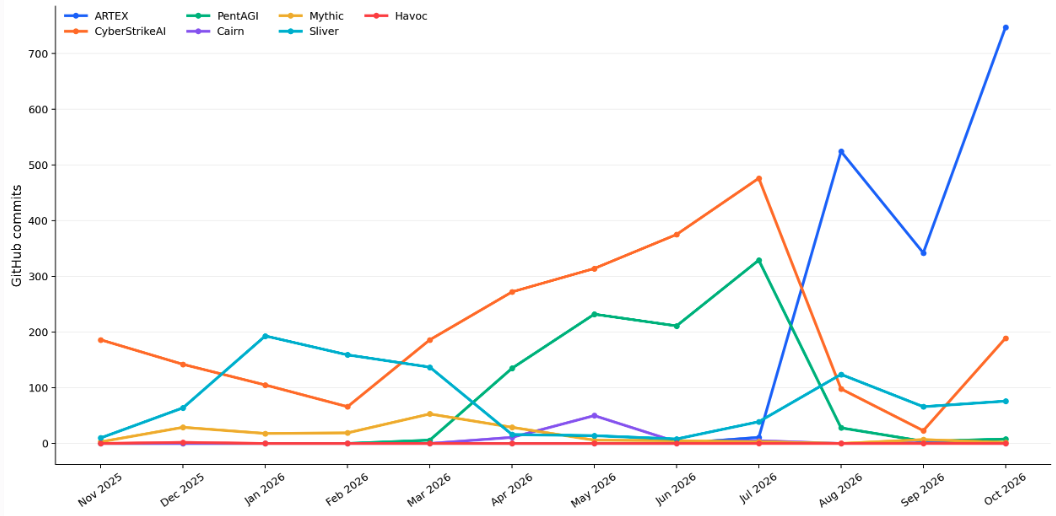
The development activity shows a much more dynamic picture than fork counts alone.
CyberStrikeAI was developed at a particularly high pace through much of 2026, peaking at 476 commits in July. PentAGI also went through a period of intensive development between April and July before activity dropped sharply. At the same time, Sliver shows that established offensive frameworks are far from disappearing: despite being released years earlier, it recorded 906 commits during the last 12 months.
Havoc represents the opposite end of the spectrum. Its repository is archived and recorded only two commits during the period, yet it continued to accumulate forks – showing that development activity and continued interest do not necessarily move together.
ARTEX stands out with a sharp increase toward the end of the period, although its commit history requires additional caution. Because the original repository was removed and our ARTEX dataset combines surviving copies, some of the visible commit history was imported into those copies and predates their creation.
Beyond adoption and development activity, we also looked at where the publicly visible infrastructure for these frameworks is hosted.
Geographic Distribution of Publicly Visible Agentic Framework Servers:
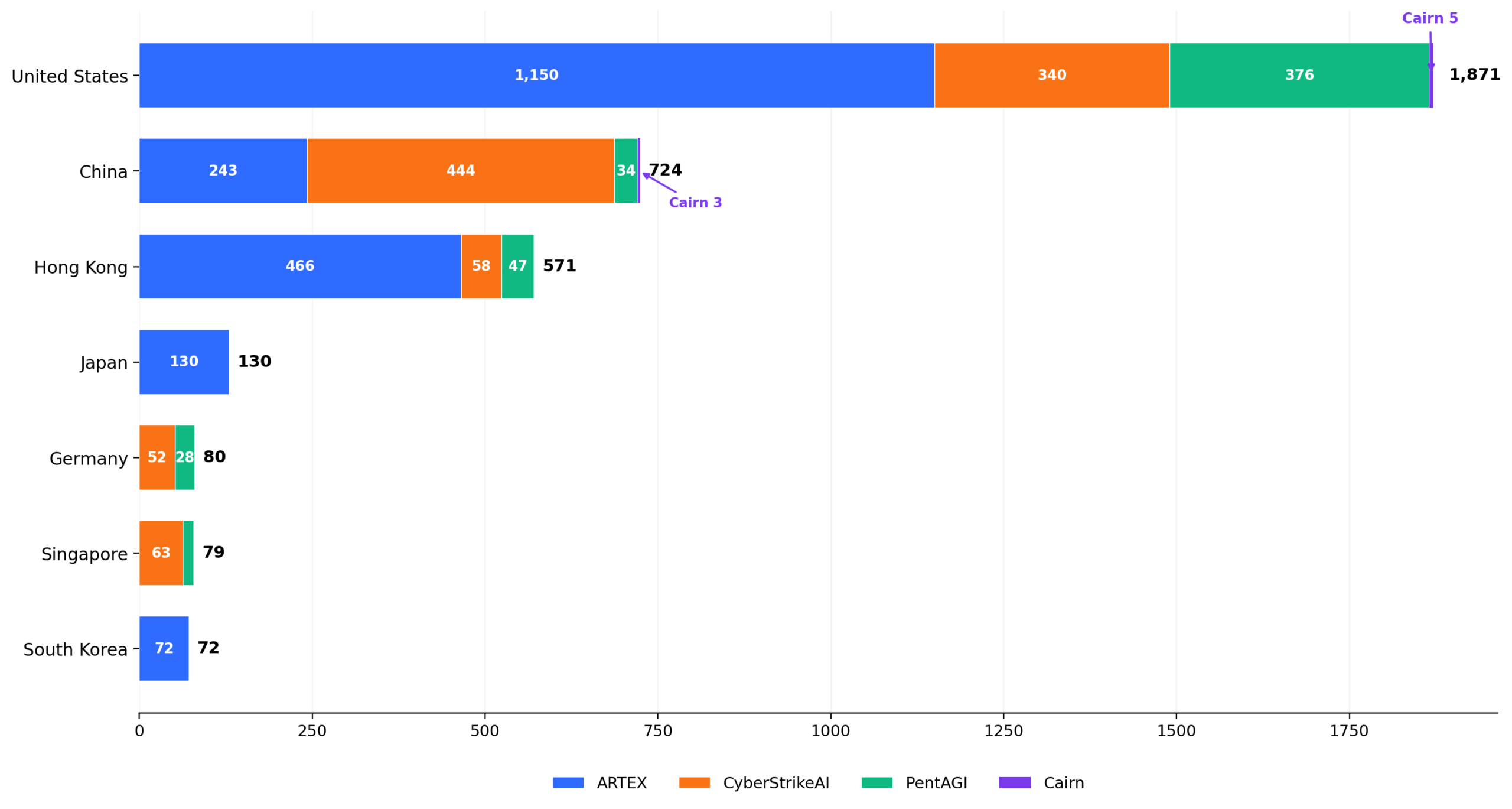
Across ARTEX, CyberStrikeAI, PentAGI, and Cairn, our searches identified more than 4,000 publicly visible servers, with the largest concentrations appearing in the United States, China, and Hong Kong.
As a closer look at ARTEX, the following view is based on Shodan data only. It gives a useful snapshot of where publicly visible ARTEX infrastructure is concentrated, but it should not be treated as a complete count. Our broader searches returned higher numbers because they also included other Internet-search engines and data sources.
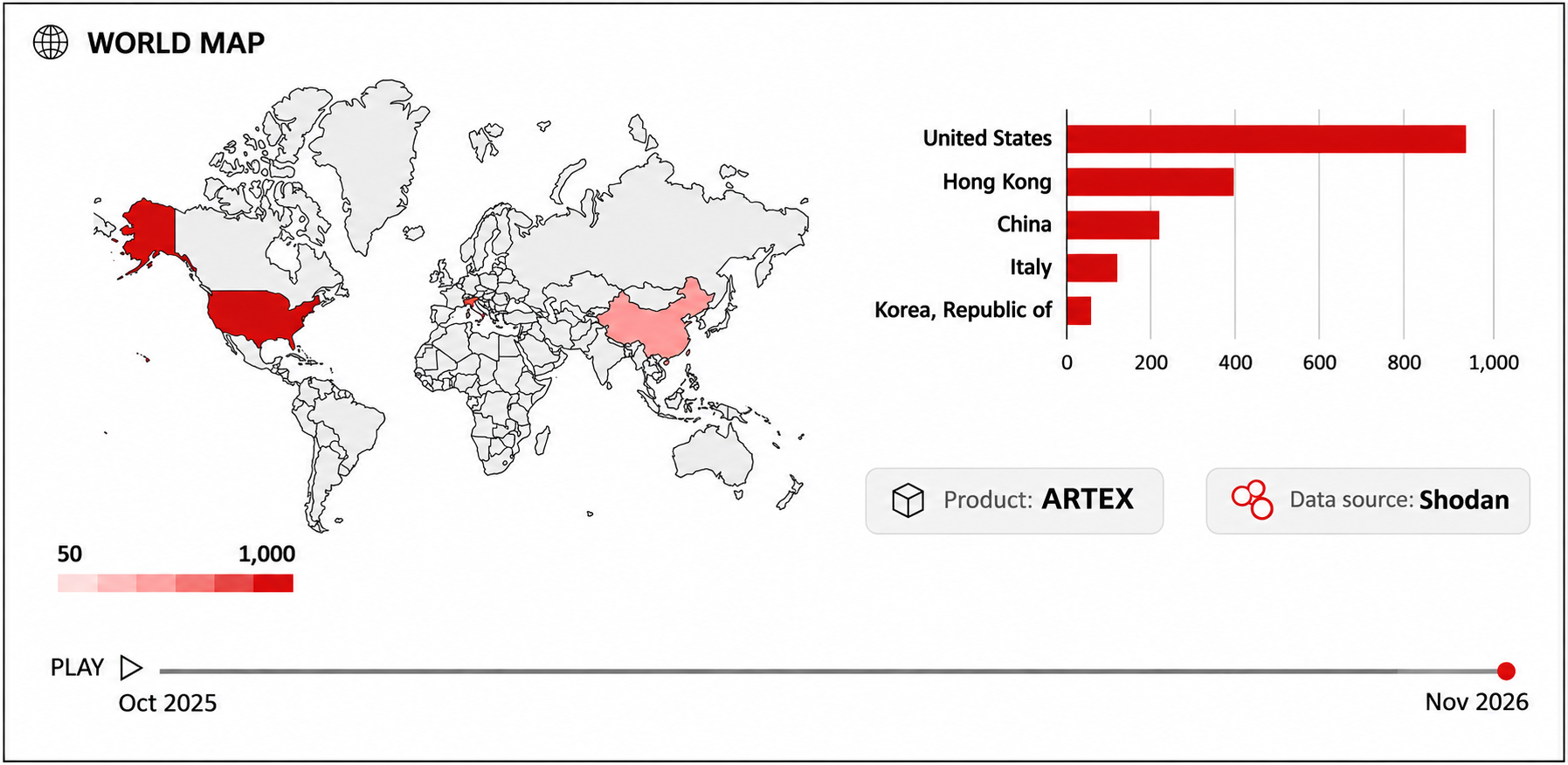
This is only the infrastructure that was publicly exposed and indexed by Internet-search platforms. The actual footprint could be significantly larger, as private, firewalled, short-lived, or otherwise non-indexed deployments would not appear in these results.
The geographic distribution reflects hosting location only; it does not indicate who operates the servers or whether they are being used maliciously.
Taken together, the data shows an ecosystem moving at different speeds: new agentic frameworks are attracting significant attention and, in several cases, rapid development, while established offensive frameworks continue to maintain their own communities and operational relevance.
We also found signs that these frameworks were attracting attention in underground communities before much of the recent public reporting around their abuse appeared. On October 6, 2026, a user on a dark-web forum explicitly asked for help learning CyberStrikeAI, HexStrike, and PentAGI.
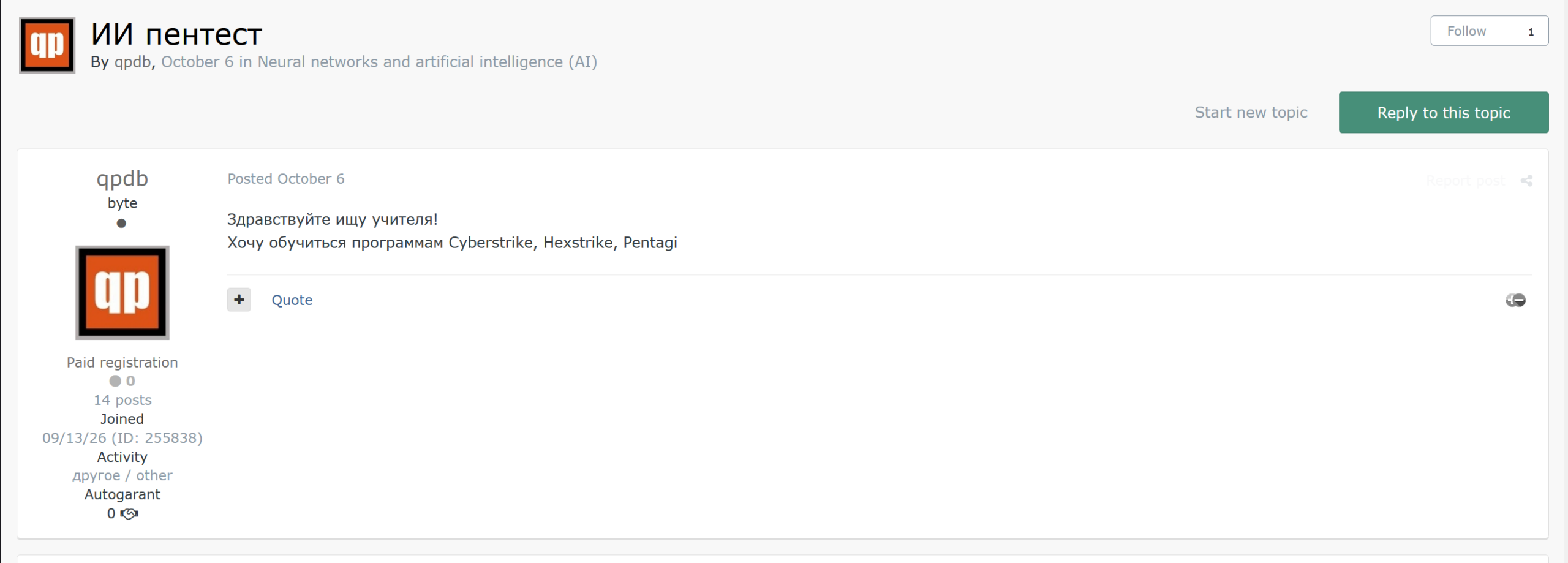
That post appeared more than two weeks before Microsoft’s October 21 ARTEX report, and several weeks before Google/Mandiant’s October 30 research, Eye Security’s November 12 incident report, and the FBI’s November 13 ARTEX warning.
The interest in learning and experimenting with these agentic offensive frameworks was already present in underground communities before they became the focus of widespread public threat reporting.
Old Tradecraft, New Operator
So far, the techniques used by these frameworks are mostly familiar. They scan, exploit known vulnerabilities, steal credentials, move laterally, establish persistence, deploy webshells or C2, and exfiltrate data.
The tools are familiar too. CyberStrikeAI integrates more than 100 existing security tools, including Nmap, Nuclei, SQLmap, Metasploit, Mimikatz, BloodHound and Impacket. PentAGI also relies on established penetration-testing tools, and ARTEX has been observed orchestrating existing offensive tooling during real intrusions.
What is different is the way these tools are used. An agent can take a result from one step, immediately decide what to try next, test several paths in parallel, and change approach when something fails.
The ARTEX incident investigated by Eye Security is a good example. After obtaining API keys, the agents started using them within minutes. When rate limiting blocked the activity, they changed their approach within roughly three minutes. They also modified an existing reGeorg tunnel to work in a load-balanced environment, changed user-agent strings to get around access controls, and tested several ways to escape from a container.
We saw similar behavior in our own Agentic Attacker research. In one run, the agent created custom vulnerability probes after standard probes failed. In another, it changed its collection workflow when the environment did not behave as expected, and it also built an SMB-based path for moving data through an existing foothold.
None of this means that AI is suddenly inventing completely new attack techniques. The bigger change is that it can combine existing techniques, adapt when blocked, and keep moving toward an objective with much less human involvement.
Cato Protection
The fact that agentic frameworks rely heavily on familiar offensive techniques also means that defenders are not starting from zero. Cato already provides multiple layers of protection against the infrastructure, tools, and behaviors used throughout these attack chains, including threat intelligence and reputation-based blocking, IPS protections, malware prevention, and identification of suspicious behaviors such as internal discovery and lateral movement.
On top of these existing controls, Cato Agentic Threat Prevention (AGTP) is designed to address the agentic nature of the attack itself. By correlating activity across the environment, identifying attack progression, and applying inline protections against likely next steps, AGTP helps contain an attack before an autonomous agent can continue progressing toward its objective. In other words, while the attacker may move faster and adapt more frequently, the defensive approach also needs to operate across the full attack chain rather than relying on a single indicator or signature.
What This Means For Defenders
Agentic offensive frameworks are evolving quickly, and the barrier to using them is getting lower. New frameworks continue to appear, existing projects can be forked and modified easily, and increasingly capable low-cost and open-weight models are making these capabilities accessible to a much wider group of operators.
That makes relying on static protections alone increasingly difficult. Defenders need multiple layers of protection and broad visibility across the attack chain – from malicious infrastructure and exploitation attempts to C2 activity, lateral movement, credential abuse, and data exfiltration.
The tools may keep changing, but the goal for defenders remains the same: detect the attack as it develops, understand how the different stages connect, and stop it before the attacker reaches the objective.


Related Articles


Cato Joins OpenAI’s Trusted Access for Cyber (TAC) to Advance AI-Driven Defense

Cato CTRL Threat Brief on Attacks Against Refrigeration Controllers