Cato CTRL Threat Brief on How Java4Shell Turns Base64 Decoding Into an Enterprise Risk


Executive summary
Java4Shell (CVE-2026-114938), disclosed on 17 November 2026, is a memory-corruption flaw in Java’s accelerated Base64 decoder. Malformed input can crash an affected JVM, and external researchers have demonstrated application-specific remote code execution. Exposure requires an affected JVM on an x86-64 processor with AVX-512 VBMI and BW support, with the vulnerable decoding path enabled and reachable by untrusted input. Potential business consequences include service disruption, exposure of application secrets and access to connected systems.
Our Agentic CVE Researcher helped accelerate Java4Shell protection development alongside Cato security researchers. This response combines agent-assisted research with human expertise to shorten the protection window. Customers gain an additional layer of protection while they assess exposure and plan runtime updates.
How Java4Shell creates business risk
The flaw occurs when malformed Base64 input reaches the affected HotSpot decoder and an integer underflow causes an out-of-bounds heap write. Exposure requires an affected JVM, an enabled vulnerable intrinsic and an x86-64 CPU with the relevant AVX-512 features, including VBMI and BW. ARM systems do not execute this path. VulnCheck reproduced crashes, while reliable code execution required additional target-specific exploitation.
The business impact depends on the application’s privileges and connections. Crashes can interrupt sign-ins or transactions, memory disclosure could expose tokens and keys, and code execution may enable access to connected systems. Calif demonstrated exploitation against products including Keycloak, Jenkins, Jira and Artifactory in specific environments and described a client-side route involving connections to a malicious TLS server. These findings do not establish that every deployment is vulnerable.
As of its 17 November advisory, Talos had not observed exploitation in the wild. The reported research demonstrates potential impact, rather than evidence of widespread compromise.
How Cato shortened the protection window
Our Agentic CVE Researcher helped accelerate Java4Shell protection development alongside Cato security researchers. The workflow combines agent-assisted vulnerability analysis and protection generation with validation and researcher review.
This shortens the path from disclosure to protection on covered traffic.
For requests targeting a vulnerable Java service, Cato IPS can block exploitation attempts that match the deployed protection on inspected traffic. Inspecting malicious content inside HTTPS requests requires TLS decryption.
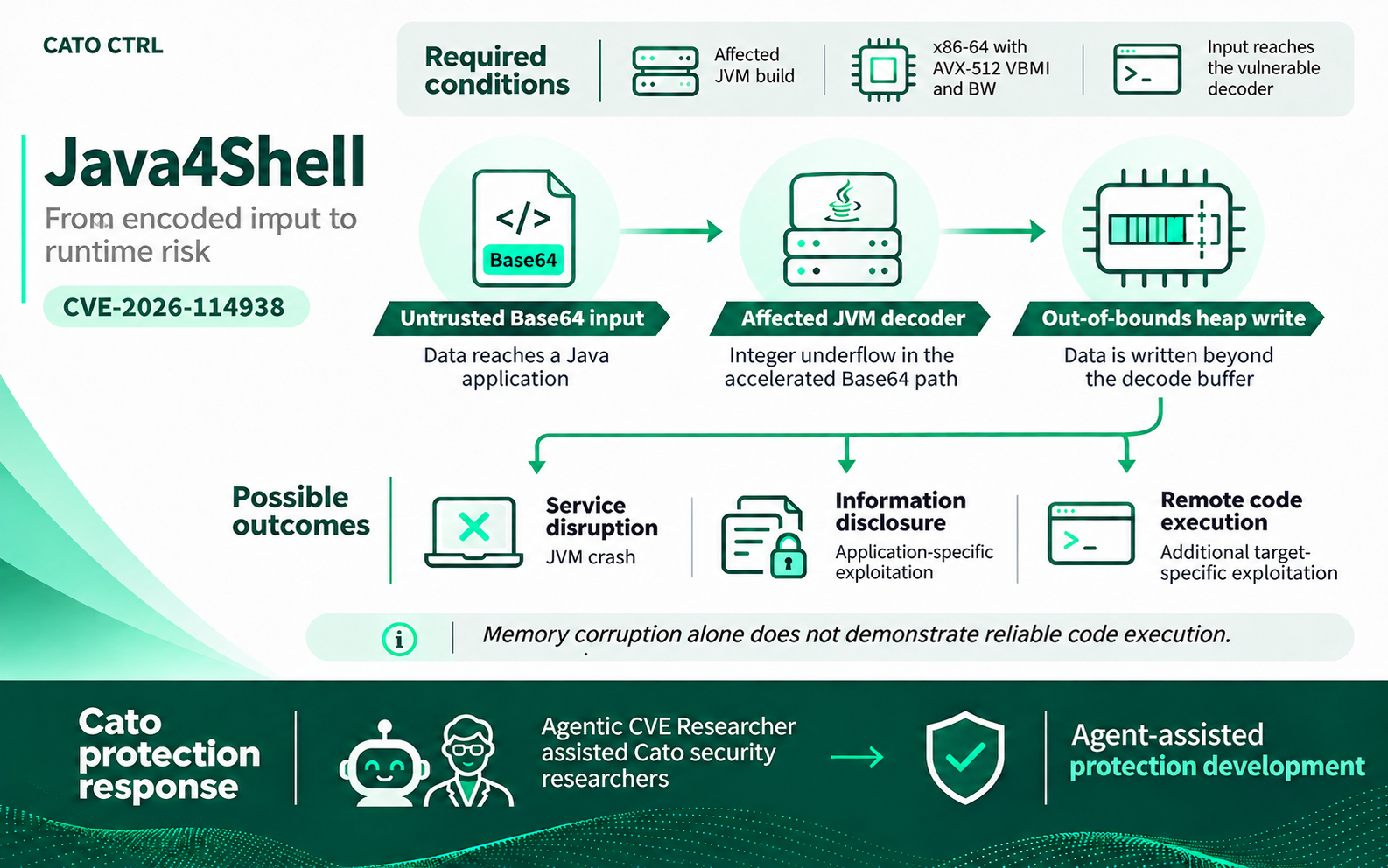
The upper flow explains the flaw and its possible outcomes. The separate Cato response shows how agent-assisted research helped add protection. Learn more about Cato’s Agentic CVE Researcher.
For private Java services, Cato firewall policies and ZTNA can restrict which users and systems can reach the application. LAN firewall segmentation can limit access from other local devices. These controls reduce the number of users and devices that can deliver malicious input to the service.
For the client-side route, restricting unnecessary outbound connections can reduce opportunities for a Java client to contact a malicious TLS server.
What this means for Cato customers
Cato IPS can block recognized exploitation patterns when the relevant protection is enabled and the traffic is inspected. Customers can focus on affected business-critical Java services and coordinate vendor-recommended runtime updates with their application owners.
Services outside that coverage may benefit from temporary access restrictions or earlier updates. If repeated JVM crashes or relevant security alerts occur, correlate them with application and network evidence to determine whether further investigation is needed.
Central protection supports distributed remediation
Java4Shell remediation spans application owners, runtime suppliers and deployment environments. Cato’s centralized architecture helps security teams distribute protections and enforce access policies across covered users, sites and cloud resources while application owners plan and validate runtime updates. The value is a shorter, more consistent protection window across inspected traffic. Confirming coverage and coordinating runtime updates completes the response, with centrally delivered protection helping manage exposure throughout the process.


Related Articles
Cato CTRL™ Threat Research: Operation Poisson – Analyzing a Cybercriminal's Entire Operation