Zero Trust Isn’t Enough for Agent Security

Table of Contents
- 1. Least privilege matters. So does what happens within it.
- 2. Agents do not exercise human judgment
- 3. Actions taken with agent privileges need runtime inspection
- 4. Where access controls and static defenses fall short
- 5. AgentSense checks every action before the agent acts
- 6. Bringing runtime protection into enterprise AI security
An AI agent can have the right identity, the right privileges, and an approved connection, and still take an unsafe action.
That’s the challenge as enterprises move from AI that answers questions to agents that do work. Agents retrieve information, invoke tools, send messages, and update business systems. They need privileges to be useful. But those privileges can also let them carry out an attacker’s instructions.
Zero Trust remains essential to agent security, but when agents act with human privileges and without human judgement, enterprises also need to verify how agents use their privileges at runtime, before an unsafe action executes.
Least privilege matters. So does what happens within it.
Zero Trust removes implicit trust and makes access conditional. Least privilege limits users and workloads to the resources and capabilities they need. NIST’s Zero Trust architecture also calls for dynamic authorization and ongoing reevaluation, extending verification beyond login.
These principles are critical for agents. An agent assigned to summarize support cases should have only the privileges needed for that task. Restricting access reduces the potential damage if something goes wrong.
Yet even narrowly scoped privileges can be misused. An agent allowed to read support records and send a summary could be manipulated into including confidential information in that message. Each operation might pass an access check while the overall behavior violates the assignment.
Permission to use a capability does not establish that a particular use is safe. Agent security must account for what happens within those privileges.
Agents do not exercise human judgment
A person reviewing a supplier proposal might recognize that instructions embedded in the document have no authority to change the assignment. Agents cannot be relied on to make that distinction consistently.
They process trusted instructions alongside emails, documents, web pages, and tool responses within the same context window. Attackers can hide instructions in that material, turning information the agent reads into directions it follows.
OWASP identifies this as indirect prompt injection: external content changes the model’s behavior in unintended ways. The consequences can include sensitive information disclosure and misuse of connected tools.
The attacker may never need to steal credentials or obtain additional privileges. They only need to influence an agent that already has access.
That makes the relationship between instructions, privileges, and actions central to agent security.
Actions taken with agent privileges need runtime inspection
An agent’s behavior takes shape as it works. Every document it reads and tool response it receives can influence its next action. Security therefore needs to evaluate that action with the context available at that moment.
Consider an agent reviewing supplier proposals. One proposal contains instructions telling it to retrieve internal pricing information and send it outside the company.
Reading the proposal is legitimate. Following those instructions is dangerous. The agent’s identity and privileges have not changed. What changed is the content influencing how it uses them.
This is why runtime verification matters. Before the task starts, that malicious influence may not be present. After the action executes, the information may already be gone.
Agent security needs an enforcement point between the agent’s proposed action and its execution. That is where unsafe influence can be detected and the action stopped, while prevention is still possible.
Where access controls and static defenses fall short
Zero Trust provides essential access controls. Agent security needs additional protection against the ways live content can redirect an authorized agent.
Different defenses leave different gaps:
- Identity and access controls establish which resources an agent can use, but do not by themselves explain whether an action serves its assigned task.
- Posture assessments and predeployment testing identify weaknesses, but cannot anticipate every input encountered in production.
- Pattern-based detection looks for recognizable attack characteristics, making unfamiliar attacks harder to catch.
- Logs and retrospective monitoring support investigation, but cannot undo a disclosure or transaction already completed.
Other vendors offer runtime protection, too. The question is what that protection evaluates and whether it can intervene before an unsafe action executes.
AgentSense checks every action before the agent acts
AgentSense, a patented breakthrough from Cato AI Labs, addresses this runtime challenge by assessing agent actions and stopping unsafe actions before execution.
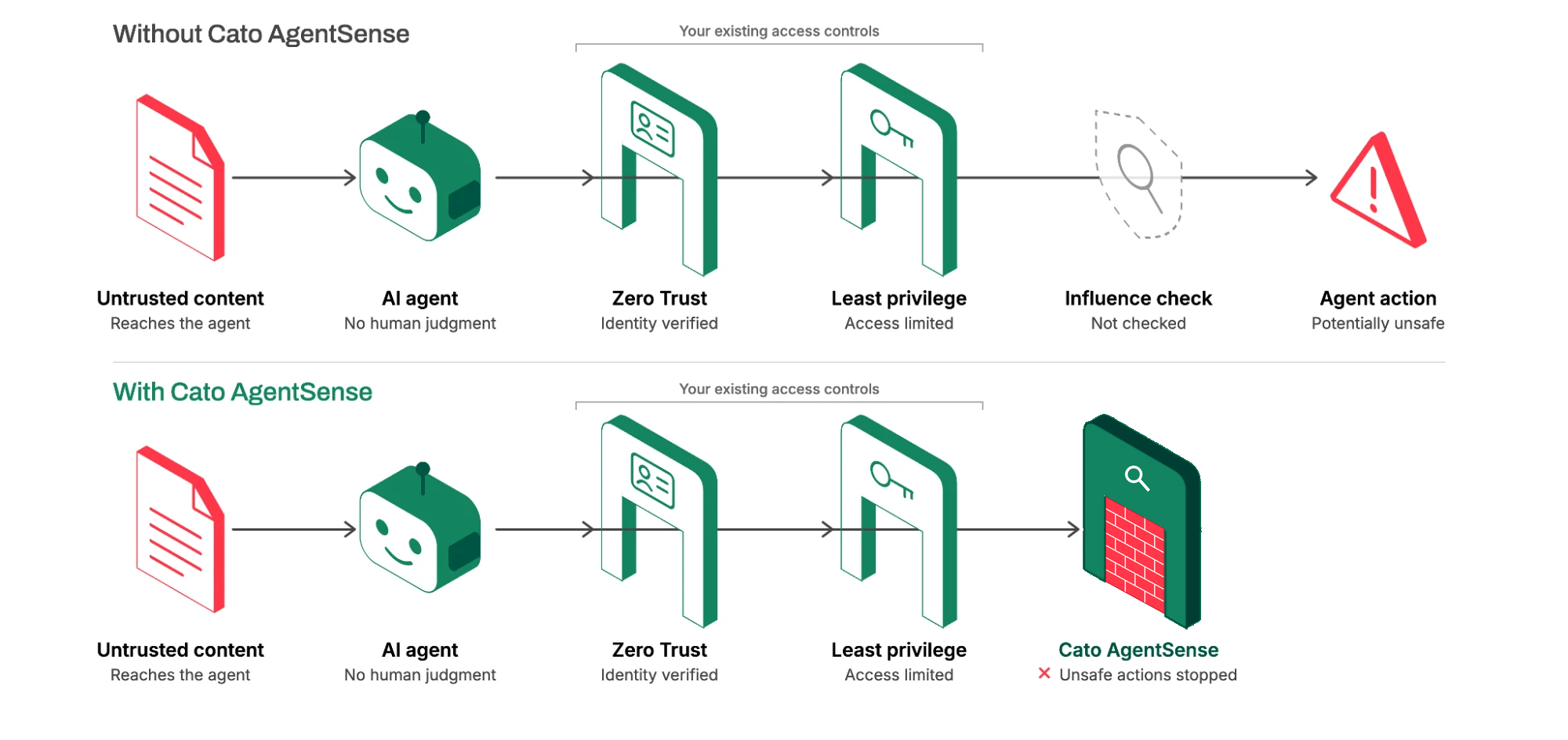
Its Untrusted Influence Detection separates trusted instructions from untrusted content and traces how that content influences agent behavior and outputs. When untrusted content steers an agent toward an unsafe action, AgentSense blocks the action before the agent executes it.
This goes beyond checking whether an input resembles a previously observed attack. AgentSense examines how untrusted content affects what the agent is about to do, helping stop indirect prompt injection even when attacks do not match known patterns. And because it focuses on the root cause of prompt injection, it is 16X more effective at detecting attacks than the next-best defense on the public AgentDojo benchmark.
AgentSense enables enterprises to:
- Verify how agents use their privileges at runtime.
- Assess trusted and untrusted influence in real time.
- Stop risky actions before execution.
Agent Security needs Zero Trust + Runtime Enforcement
Bringing runtime protection into enterprise AI security
Cato brings agent protection into its converged network and security cloud, connecting visibility, policy, and enforcement across local, custom, and managed agents. Cato Agentic AI Security
Cato AI Security also protects the applications enterprises build, inspecting prompts, responses, and agent actions at runtime to help prevent data exposure and enforce policy. Cato AI Security for Applications
Zero Trust establishes the boundaries of an agent’s access. AgentSense verifies how the agent operates within them, at runtime, before unsafe influence becomes harmful action.


Related Articles