Beyond Model Access: Frontier AI Defense Needs Runtime Prevention

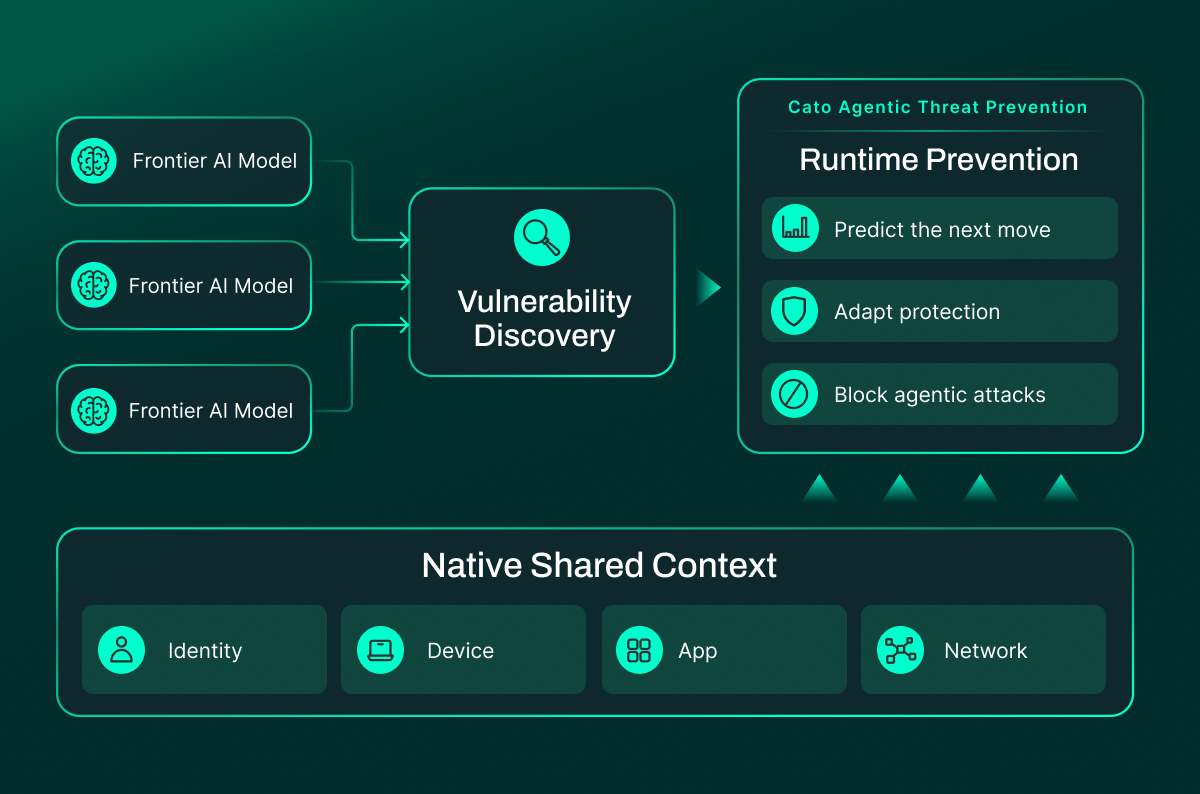
Table of Contents
Access to powerful AI models is opening new possibilities for cybersecurity. Models can help uncover weaknesses, investigate threats, and explore how attackers might break into an environment. Using several models can bring different strengths to that work.
But model access alone does not answer a critical question: can your defense stop an attack while it is happening?
In the frontier AI era, discovery needs to connect to action. Defenders need to understand an unfolding attack, anticipate the next move, and adapt protection as the attacker changes direction. That is why runtime prevention belongs at the center of the conversation… all at agentic (not patchy) speed.
More Models Are Only Part Of The Answer
Finding a weakness gives defenders information they can use. Investigating an attack path helps them understand what could happen. Both are valuable, but neither automatically blocks an attacker. There’s more required.
The next step depends on how that intelligence connects to security controls. Can the defense act on what it learns? Can it apply protection where traffic flows? Can it adjust when the attacker tries something different?
Models can support those decisions. They need current information about the environment and a way to put their conclusions into action. The number of models matters less than what the complete defense can do with them.
The Attack Changes. Protection Needs To Change With It.
An agentic attacker can try an action, observe the result, and change tactics. If one route fails, it can switch tools, methods, or targets. Blocking the first attempt may interrupt the attack, but the attacker can keep pursuing the same objective.
A defense needs to carry forward what it has learned. A new connection or tool should be evaluated alongside earlier activity, so a change in tactics does not erase the understanding built so far.
With Cato Agentic Threat Prevention, we connect that understanding to attack prediction and adaptive protection. Our goal is to anticipate where an attacker could go next and block its progress as the attack unfolds.
Native Shared Context Makes The Difference
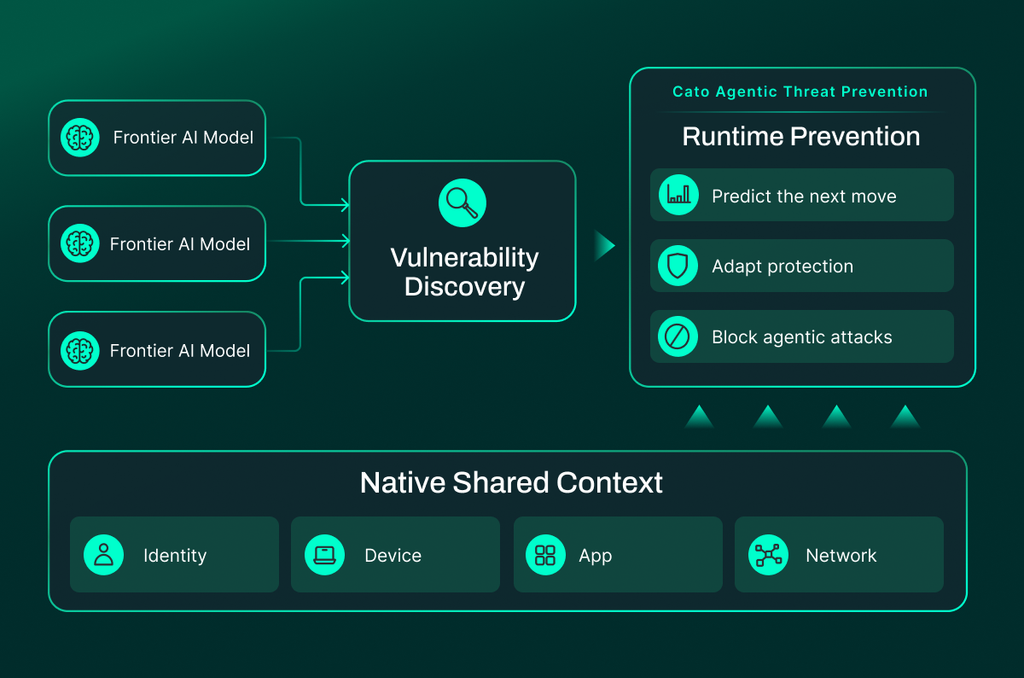
That ability starts with shared context. Identity, device, application, and network activity become more useful when evaluated together with security events and threat intelligence. An action that appears ordinary on its own can mean something different when connected to the surrounding activity.
Our architectural advantage is that this context is native to the Cato platform. Our networking and security capabilities observe activity within the same environment and contribute to a shared understanding of it.
That gives our defensive agents information from the platform inspecting the traffic. They can reason across connected signals, with the detail and relationships needed to understand a developing attack.
Our native shared context helps connect what happened earlier with what is happening now and what could follow. As an attacker changes tactics, our defense carries that understanding forward.
Runtime Prevention Turns Understanding Into Action
Cato Agentic Threat Prevention uses shared context to predict likely attack paths and create protections tailored to each customer’s environment. Those protections adapt as new signals appear and attacker behavior changes.
Three capabilities work together:
- Predict the next move. Use activity and context across the environment to anticipate how an attacker could possibly advance.
- Adapt protection. Automatically adjust policies to disrupt predicted actions and evolving attack paths.
- Enforce at scale. Apply protections through our global cloud platform, with resources that scale as demand grows.
These capabilities operate within our Single Pass Cloud Engine, connecting threat understanding to enforcement. The result is a defense designed to keep adapting throughout a multi-stage attack.
For security leaders, the practical test is what happens after the first block. Does the defense recognize the next attempt? Does it retain context? Can it change protection before the attacker advances?
Agentic CVE Mitigation Adds Another Layer Of Protection
Protecting against evolving attacks also means addressing newly disclosed vulnerabilities. Agentic Threat Prevention and Agentic CVE Mitigation serve complementary roles: one anticipates attack progression, while the other rapidly applies protection against new vulnerabilities.
Our Agentic CVE Mitigation autonomously assesses and applies protections for newly disclosed vulnerabilities in as little as 45 minutes.
Relying on individual security appliance updates can introduce delays and inconsistencies through signature testing, policy variations and uneven rollout. Our cloud platform delivers new protections without requiring customers to update appliances across their environments.
Organizations still need to patch vulnerable systems. Cloud-delivered protection helps cover that work while teams complete the underlying fixes. Together, these capabilities support protection against both newly disclosed weaknesses and attacks that change direction.
Make Active Prevention the Measure
Frontier AI defense should be judged by its ability to turn intelligence into protection. Finding more weaknesses is beneficial. Connecting those findings and live activity to controls that can stop attack progression is critical.
At Cato, we bring native shared context, adaptive runtime prevention, and rapid vulnerability protection together. That is agentic defense in action: using what our platform knows to anticipate and block what the attacker tries next.


Related Articles
When the Enterprise Edge Is Everywhere, Security Must Be Too

Meeting the Retail Industry’s Evolving Cybersecurity Needs


Sentra and Cato XOps: Turning Data Risk into Active Mitigation